
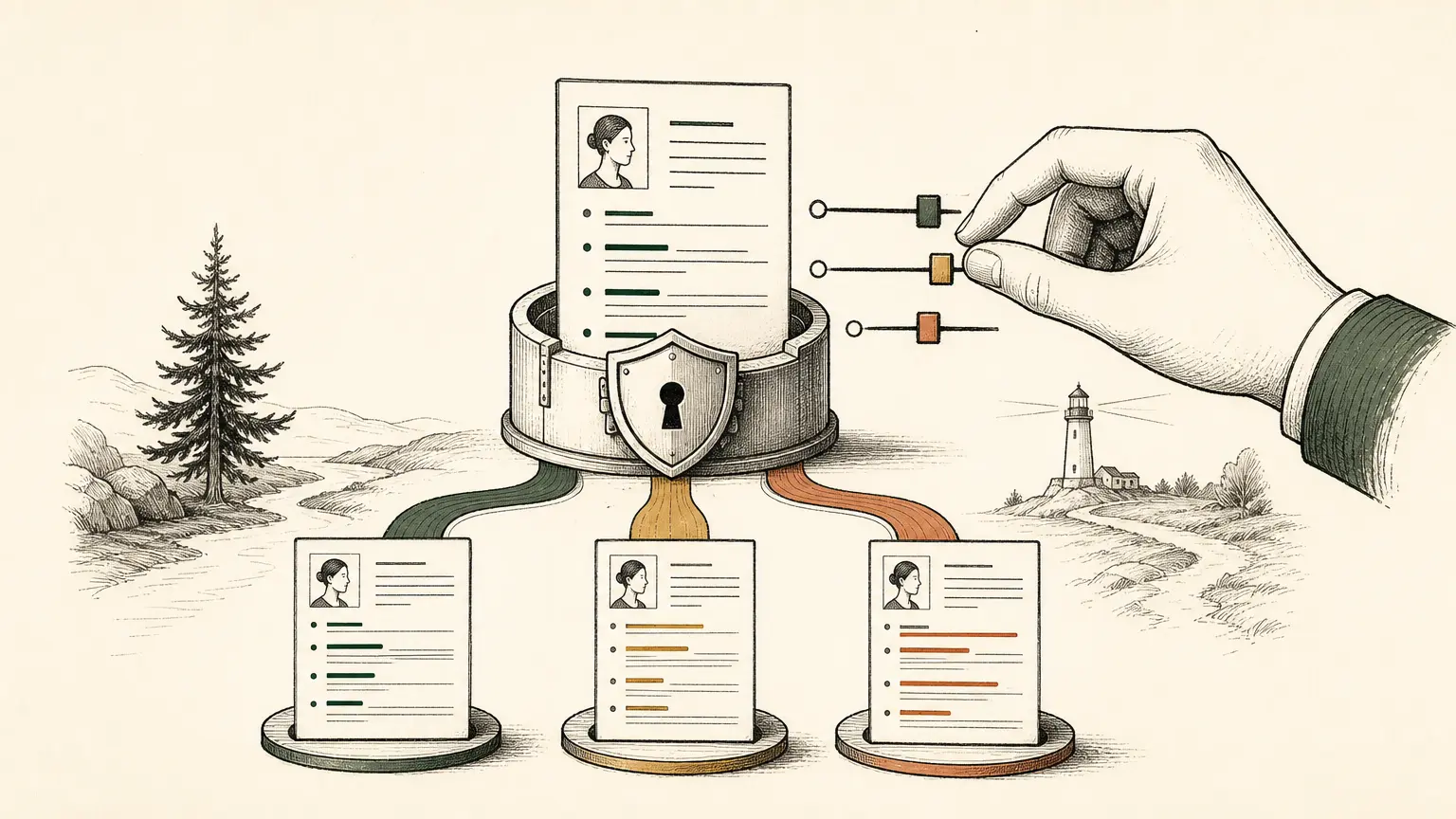
You should tailor your resume for serious opportunities, but you should not rebuild your resume from scratch for every posting.
That distinction matters because job seekers are being pulled in two directions. Monster's 2026 survey found that 68% of U.S. job seekers spend less than 30 minutes tailoring each application, while 77% worry their resume is filtered before a human sees it.1
That is the perfect recipe for frantic editing.
Tiny CV's view is simpler: the facts stay stable; the emphasis changes. Tailor the resume effort, not the truth.
Should you tailor your resume for every job?
Tailor your resume selectively by matching the edit effort to the role's fit, value, and evidence requirements.
Think of tailoring like packing for a trip. You do not buy a new wardrobe for every weekend, but you also do not bring a ski jacket to a beach interview. The point is fit.
A generic resume is useful as a clean baseline. CareerOneStop tells job seekers to make relevant qualifications easy for employers to find, and Duke's Career Hub warns against sending a generic resume when a tailored one can show clearer alignment.23
But "tailored" does not mean "new identity." It means changing section order, bullet order, summary focus, and truthful terminology so the strongest evidence appears sooner.
Monster career expert Vicki Salemi frames the 2026 resume problem as a balance between speed, customization, and credibility.1 That is the job here: enough customization to be legible, not so much rewriting that the resume starts drifting from reality.
The resume tailoring decision tree
The best resume tailoring framework is: use the smallest truthful edit that makes your fit obvious.
| Situation | Fit signal | Effort level | What to change | What not to change |
|---|---|---|---|---|
| Low-fit or speculative role | You meet few must-haves | Baseline | Send the clean current version | Do not keyword-stuff gaps |
| Broadly aligned role | You meet most core requirements | Light tailor | Reorder bullets, adjust headline, mirror true terms | Do not add skills you cannot use |
| High-fit, high-value role | The role matches your strongest proof | Role-specific version | Select stronger projects, compress weak proof, check page fit | Do not change dates, titles, metrics, or scope |
| Missing required experience | A must-have is absent | Honest apply or skip | Use adjacent evidence if real | Do not invent the missing requirement |
Use the decision tree this way:
IF the role is low-fit or speculative, THEN send the baseline and spend effort elsewhere. Your time is part of the application strategy.
IF the role is broadly aligned, THEN do a 10-15 minute light tailor. Highlight the top 3-5 requirements, move matching proof higher, and use the employer's wording only where it is already true.
IF the role is high-fit or high-value, THEN create a role-specific version from the source of truth. Versions are good; drift is bad. Start from a trusted Tiny CV markdown draft, select the proof that belongs in this version, and preview whether the page still reads cleanly.
IF the role requires experience you do not have, THEN do not fake it. NACE's career-readiness competencies are useful for finding transferable evidence, but transferable is not the same as fictional.4
What counts as tailoring, and what crosses the line?
Resume tailoring is safe when it changes emphasis around real experience and unsafe when it changes the underlying facts.
Safe tailoring:
- Move the most relevant role, project, or bullet closer to the top.
- Rename a section truthfully, such as "Research Experience" for research-heavy work.
- Replace vague wording with exact terminology you can defend.
- Export a role-specific PDF while keeping the source record stable.
Unsafe tailoring:
- Invent employers, titles, dates, credentials, customers, tools, or metrics.
- Inflate "helped" into "owned" when you did not own the work.
- Add keywords as a loose skills list without evidence in the bullets.
- Claim outcomes that are not supported by your notes, manager memory, or work artifacts.
UIC's ATS guidance recommends using job-description language in context, not just as a list of skills.5 That is the line. "Triaged recurring setup issues from support tickets" is a truthful edit if you did that work. "Owned customer research program" is not.
Tiny CV's rule is facts before phrasing. If AI is involved, pair this section with the safest way to let an AI agent edit your resume: the agent can suggest phrasing, but you own the claim.
Use three levels of resume customization
Resume customization works best when you choose one of three effort levels before you start editing.
Level 0: baseline send. Use this for networking asks, broad profile submissions, low-fit roles, or jobs where your current resume already makes the fit obvious. The baseline still needs to be clean, accurate, and readable.
Level 1: light tailor. Spend 10-15 minutes. Save the job description, mark 3-5 must-have requirements, move matching proof higher, adjust the headline or summary, and remove one weak line if space is tight.
Level 2: role-specific version. Spend 30-45 minutes for roles that are high-fit or high-value. Start from your resume source of truth, choose the strongest role-relevant projects, compress unrelated work, preview the page, and export a named PDF.
Only do a full rebuild when the target category changes. Founder to product manager, academic CV to private-sector resume, or generalist to technical specialist may require a deeper rewrite.
That is why Monster's 68% less-than-30-minutes finding matters.1 Most people cannot sustain deep rewrites at real job-search volume. The framework gives your effort a budget.
Targeted resume vs generic resume
A targeted resume is better than a generic resume for high-fit applications because it makes the relevant proof easier to find.
| Version | Best use | Main risk | Editing rule |
|---|---|---|---|
| Generic baseline | Low-fit, early networking, broad profiles | Strong proof may be buried | Keep it accurate and clean |
| Targeted resume | High-fit applications | Over-editing if every line chases the posting | Change emphasis, not facts |
| Over-tailored resume | Almost never | Sounds matched but brittle, bloated, or inaccurate | Cut back to defensible evidence |
The targeted version wins when the job is worth the effort. The baseline still has a job.
Clarity matters more than bloat. Monster found that 49% of job seekers now use resumes longer than one page, 30% use two pages or more, 43% believe hiring managers only skim resumes, and just 6% believe resumes are read thoroughly.1
That does not prove every resume must be one page. It does mean every added line should earn its space. Use the one-page resume forcing function when tailoring starts turning into storage.
How AI can help without flattening your resume
Use AI to tailor your resume only as an editor and gap reviewer, not as the source of truth.
Good AI tasks:
- Extract the job's top requirements.
- Compare those requirements with your resume.
- Suggest reorder, cut, and clarify edits.
- Show before-and-after bullets.
- Flag unsupported claims instead of filling them in.
Bad AI tasks:
- Generate a whole identity from a job description.
- Add metrics, tools, credentials, or outcomes.
- Rewrite every bullet into the same polished voice.
- Optimize for every keyword at the cost of interview-defensible truth.
Use a boundary like this:
Use only these facts. Mark unsupported claims. Propose diffs.
Do not invent employers, dates, titles, metrics, tools, credentials,
customers, or outcomes.
NIST's AI Risk Management Framework is not resume advice, but its govern, map, measure, and manage functions are a useful discipline: set boundaries before using AI, identify the risky edits, review the output, and manage what goes into the final document.6
The evidence is still early and mixed. Resume.io's 2025 vendor survey of 3,000 hiring managers reported that 49% said they automatically dismiss AI-generated resumes, which should be treated as a caution signal rather than a universal rule.7 Amanda Augustine, its career expert and a certified resume writer, ties that risk to authenticity and credibility concerns.
Tilburg researchers Kian Abbas Nejad, Giuseppe Musillo, Till Wicker, and Niccolò Zaccaria found that AI improved cover-letter quality in experiments but did not increase interview invitations; Tilburg's 2026 release also says recruiters were no better than chance at detecting AI-written cover letters.89 Zaccaria's warning is the important one for resumes: when AI compresses everyone into similar signals, matching can get worse.
A May 2026 arXiv case study by Kumar Abhinav points in the same practical direction. In a nine-job-description pilot, a career vault improved ATS-style fit scores by 7.8 points for six same-occupation job descriptions, but scores fell by 8.0 points for two absent-domain job descriptions.10
Grounded AI helps when the experience exists. It gets dangerous when the job needs evidence you do not have.
A Tiny CV workflow for sustainable tailoring
Sustainable resume tailoring is a versioning problem, not a nightly rewrite ritual.
Start with one canonical Tiny CV markdown record. Keep employers, dates, titles, metrics, links, and private evidence notes there. Then duplicate a role-specific version when the opportunity deserves it.
The workflow is:
- Keep the baseline facts stable.
- Duplicate a version for the role.
- Adjust emphasis and ordering.
- Preview the paper fit.
- Export the PDF for systems.
- Share the hosted public link for humans when useful.
Tiny CV's role-specific versions stay tied to the canonical markdown source, so you can review the markdown diff, ask an agent to check the changed lines, and keep the public export separate from private evidence.
That is how you reduce tailoring fatigue without sending the same resume everywhere.
The pre-send check
Before sending a tailored resume, confirm that the version is clearer, truthful, and worth the time you spent on it.
Run this checklist:
- Does this version answer the job's top 3-5 requirements with real evidence?
- Did any fact change from the source of truth?
- Did AI add anything you cannot defend?
- Is the most relevant proof visible near the top?
- Is the PDF readable and clean?
- Is this opportunity worth another edit, or should you send and move on?
The recommendation is direct: use a full role-specific version for high-fit, high-value roles; do a light edit for adjacent roles; send the baseline for low-fit or speculative submissions; and never change facts to match a posting.
Tiny CV can keep those versions organized, but the judgment is still yours.
Footnotes
-
Monster, "2026 State of Resumes Report," and PRNewswire, "Resumes Are Getting Longer, Not Clearer, as ATS Anxiety Hits 77%," January 22, 2026, https://www.monster.com/career-advice/research/state-of-the-resume-2026 and https://www.prnewswire.com/news-releases/resumes-are-getting-longer-not-clearer-as-ats-anxiety-hits-77-302666925.html ↩ ↩2 ↩3 ↩4
-
CareerOneStop, U.S. Department of Labor, "Target your resume," https://www.careeronestop.org/HowTo/FindAJobNow/target-your-resume.aspx ↩
-
Duke Career Hub, "Tailor," https://careerhub.students.duke.edu/tailor/ ↩
-
National Association of Colleges and Employers, "What is Career Readiness?", https://www.naceweb.org/career-readiness/competencies/career-readiness-defined/ ↩
-
University of Illinois Chicago Career Services, "Optimizing Resumes for Applicant Tracking Systems (ATS)," https://careerservices.uic.edu/wp-content/uploads/sites/26/2017/08/Ensure-Your-Resume-Is-Read-ATS.pdf ↩
-
National Institute of Standards and Technology, "AI RMF Core," AI Risk Management Framework 1.0, 2023, https://airc.nist.gov/airmf-resources/airmf/5-sec-core/ ↩
-
Amanda Augustine and Robert Lyons, Resume.io, "Study: 49% of hiring managers reject AI-generated resumes," updated January 22, 2025, https://resume.io/blog/resume-rejections ↩
-
Kian Abbas Nejad, Giuseppe Musillo, Till Wicker, and Niccolò Zaccaria, "Labor Market Signals: The Role of Large Language Models," CentER Discussion Paper 2025-003, Tilburg University, March 18, 2025, https://research.tilburguniversity.edu/en/publications/labor-market-signals-the-role-of-large-language-models/ ↩
-
Tilburg University, "AI improves cover letters, but worsens matching in the labor market," April 14, 2026, https://www.tilburguniversity.edu/current/press-releases/ai-improves-cover-letters-worsens-matching-labor-market ↩
-
Kumar Abhinav, "Career-Aware Resume Tailoring via Multi-Source Retrieval-Augmented Generation with Provenance Tracking: A Case Study," arXiv:2605.05257, May 6, 2026, https://arxiv.org/abs/2605.05257 ↩