
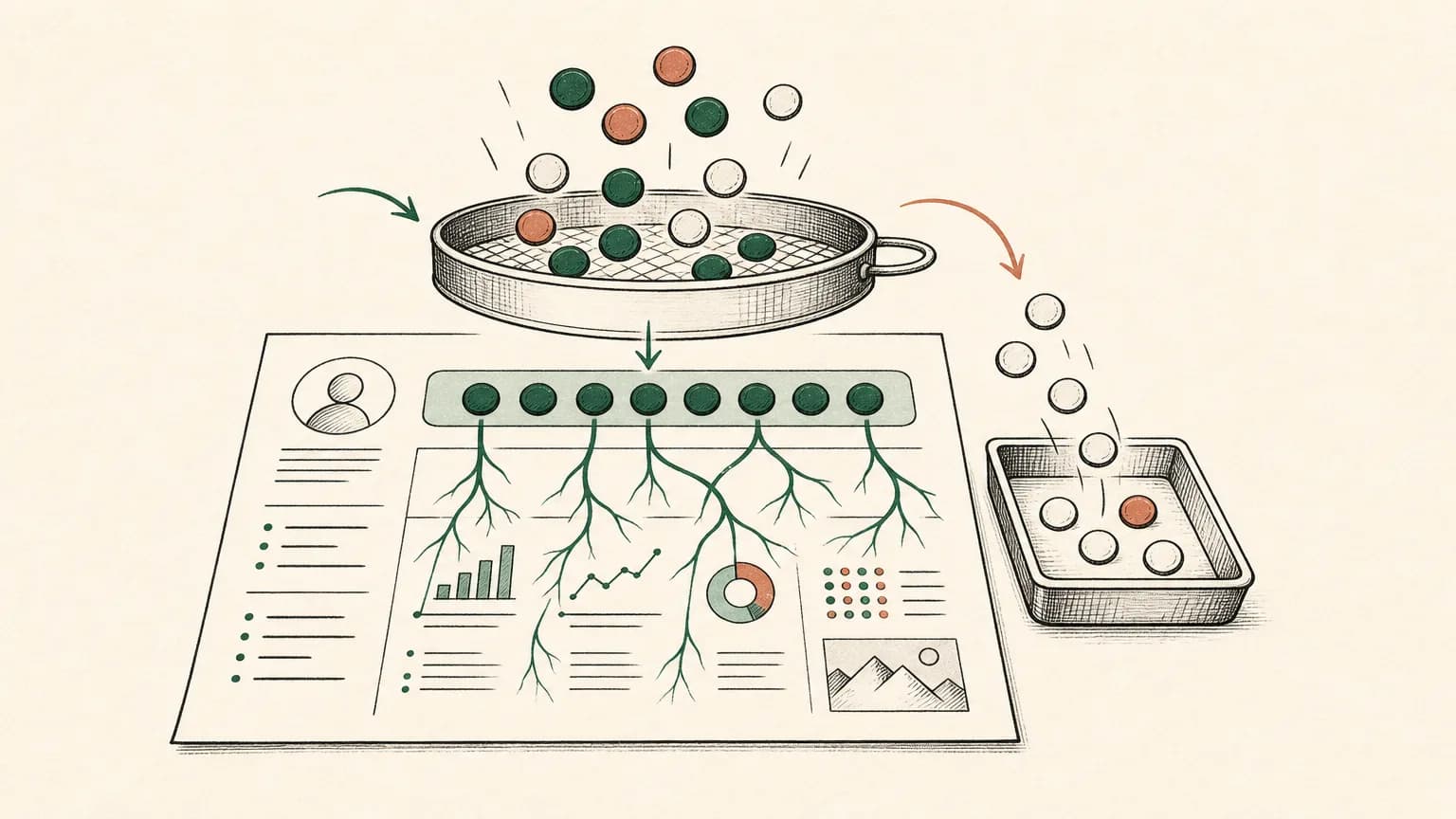
A resume skills section should list truthful, role-relevant skills that help a recruiter or system find your fit quickly.
It should not carry the whole resume.
Think of it like the index at the back of a book. The index helps someone find the topic. The pages prove the topic exists. Tiny CV's rule is the same: facts before phrasing, source of truth before polish, and every important skill should point somewhere real.
The practical filter is simple: List / Prove / Omit.
List skills that are searchable and defensible. Prove the important ones in bullets. Omit anything that sounds good but would fall apart in an interview.
What should a resume skills section actually do?
A resume skills section should give an immediate view of the tasks, tools, credentials, languages, and domains you are ready to use.
That sounds small because it is small. The skills section is not your argument. It is the label on the evidence.
Wellesley Career Education describes the skills section as an immediate view of the kinds of tasks a candidate is ready to undertake, while warning against generic skills like people skills, time management, and critical thinking.1 The University of Texas at Dallas Career Center gives an even sharper rule: list skills you can honestly speak to, but work soft skills into bullet points instead of dropping them into the Skills section.2
Here is what this means for you.
If a job asks for Python, SQL, Spanish, HubSpot, Kubernetes, SOC 2, Figma, or financial modeling, a compact skills section can help those terms surface fast. If a job asks for communication, leadership, teamwork, or problem solving, the list alone is weak.
"Communication" is a claim.
"Wrote weekly rollout notes for product, sales, and support so customer-facing teams could answer billing questions from the same source" is proof.
How does the List / Prove / Omit decision tree work?
The List / Prove / Omit decision tree turns every possible skill into one of three actions: list it, prove it, or cut it.
Use it before you start polishing. Polished unsupported skills are still unsupported.
1. Is the skill named in the job description or strongly implied by the role?
If no, omit it unless it is a clear differentiator for the role: a license, language, domain, certification, or technical capability that changes how the reader understands you.
If yes, keep going.
NACE reported that more than 80% of employers highlight key skills needed for a position when creating job descriptions.3 The posting is not perfect, but it is your best first map.
NACE's 2026 Spring Update also found that more than half of employer respondents named 10 or more skills they look for on resumes.4 That does not mean you should list 10 random skills. It means the filter matters.
2. Is it a hard skill, tool, domain, language, method, certification, or license?
Usually list it compactly.
Examples: TypeScript, Python, Excel, Salesforce, Figma, Kubernetes, financial analysis, HIPAA, Spanish, forklift certification, user research, accessibility testing.
3. Is it a soft or behavioral skill?
Usually prove it in bullets.
Examples: communication, leadership, teamwork, adaptability, problem solving, ownership, professionalism, stakeholder management.
NACE defines career readiness through eight competencies, including communication, critical thinking, teamwork, professionalism, leadership, technology, career and self-development, and equity and inclusion.5 Those are real workplace skills. They just need situations, not labels.
4. Is this one of the 3-5 skills most likely to decide the interview?
List it and prove it.
If React is central to the role, React belongs in the skills section and in a bullet or project. If SQL is central, the resume should show what you queried, analyzed, automated, or reported. If leadership is central, the reader should see who you led, through what problem, toward what outcome.
5. Can you defend the skill in an interview?
If no, omit it.
This is where skills-based hiring changes the resume standard. NACE's Job Outlook 2026 research says 70% of participating employers report using skills-based hiring, up from 65% the prior year.3 The same article says GPA screening fell from 73% of employers in 2019 to 42% in 2026.3
That shift is good for candidates with real experience. It is bad for candidates who only have vocabulary.
Shawn VanDerziel, NACE's president and CEO, put the point plainly in NACE's 2026 high-impact skills release: candidates should not merely list skills because employers want examples.4 Your resume should be ready for that follow-up.
What skills should you put on a resume in 2026?
The best skills to put on a resume in 2026 are the truthful, job-relevant skills the target role will search for and judge.
Do not start from a universal list. Start from the role.
The U.S. Department of Labor describes ONET as a system that organizes occupations by knowledge, skills, abilities, tasks, work activities, and other descriptors.6 ONET OnLine says its database covers more than 900 occupation profiles and more than 55,000 jobs across the U.S. economy.7
That is the right mental model. Different roles require different skill mixes.
Use this table as a placement guide:
| Skill type | Examples | Best placement | Proof required |
|---|---|---|---|
| Hard or tool skills | Excel, Python, SQL, Salesforce, Figma, AutoCAD | Skills section; bullets for central skills | Hands-on use |
| Technical stack | TypeScript, React, Node.js, PostgreSQL, AWS, Kubernetes | Grouped skills section plus projects or work bullets | Real build, maintenance, analysis, or operations |
| Domain skills | Fintech, healthcare operations, claims processing, SOC 2, logistics | Summary, skills, and relevant bullets | Exposure to the domain and accurate scope |
| Methods and frameworks | Agile, user research, accessibility testing, incident response, financial modeling | Skills if searchable; bullets if important | How you applied the method |
| Languages | Spanish, Mandarin, ASL, French | Skills or languages section | Honest proficiency level |
| Certifications and licenses | CPA, PMP, AWS certification, nursing license, OSHA training | Certifications, education, or skills | Earned or clearly in progress |
| Transferable soft skills | Communication, teamwork, leadership, problem solving | Experience bullets | A situation that shows behavior |
| Role responsibilities | Onboarding, stakeholder reporting, vendor management, QA testing | Bullets; skills only when searchable | Scope, audience, and action |
CareerOneStop's Skills Matcher, sponsored by the U.S. Department of Labor, asks users to rate 40 workplace skills.8 That is useful as a prompt, not a resume template.
Your final list should feel smaller than your full ability set.
A resume skills section is not the place to prove you are generally employable. It is the place to make your most relevant skills findable.
Where should hard skills and soft skills go?
Hard skills usually belong in the skills section, while soft skills usually belong in bullets that show the behavior.
That is the fastest way to make the section useful without turning it into filler.
Hard skills are easier to list because they are usually discrete and searchable: Java, Tableau, QuickBooks, CNC machining, Google Analytics, Spanish, CPR certification, construction estimating. If the skill is true and relevant, list it compactly.
Soft skills are different. "Leadership" can mean chaired a student group, managed three engineers, led a sales territory, coached new cashiers, or coordinated volunteers during a crisis. The word alone hides the important part.
UTD's resume guidance says soft skills such as communication, active listening, and customer service do not go in the Skills section and should be worked into bullet points.2 University of Michigan Engineering Career Resource Center says not to force soft skills into a resume by merely listing them because they mean little without evidence.9
Use this pattern:
| Weak list-only claim | Stronger proof placement |
|---|---|
| Communication | Wrote release notes for product, support, and sales before each billing launch. |
| Leadership | Coordinated four volunteers during weekly food distribution shifts. |
| Problem solving | Traced recurring signup failures to mismatched account states and documented the fix for support. |
| Teamwork | Partnered with design and QA to test checkout error states before launch. |
| Adaptability | Covered front-desk scheduling during a staffing gap while maintaining daily patient intake. |
There is one exception.
If the posting explicitly names a soft skill and the wording matters, you can echo it once. But the bullet still has to carry the proof.
How do you build an ATS-readable skills section without keyword stuffing?
An ATS-readable skills section uses standard headings, plain text, truthful keywords, and enough nearby evidence that the list does not read like stuffing.
Use the heading Skills. Do not call it "Toolbox," "Superpowers," or "What I Bring." Clever labels make humans pause and systems guess.
Workday describes an applicant tracking system as software that acts as a central database for candidate information and helps recruiters post jobs, gather applications, screen candidates, and manage hiring workflows.10 Greenhouse says resume parsing scans an imported resume and auto-fills detected fields, and it flags formatting issues such as tables, headers, footers, text boxes, columns, graphics, and unclear sections as parse risks.11
So keep the mechanics boring:
- Use the standard heading
Skills. - Keep the text selectable.
- Group long technical lists only when grouping improves scanning.
- Use terms from the job description only when they match real experience.
- Put central skills in bullets too, not only in the list.
- Do not hide keywords, repeat terms unnaturally, or paste the job description into the resume.
UVA Career Center says critical keywords should be integrated within bullet points rather than only listed in a Skills section.12 iCIMS says ATS tools may scan for keywords, rank candidates by criteria, and let recruiters refine results by weighting keywords, while also warning that old keyword-stuffing tricks are not the path.13
The practical line is this: searchable is good; padded is weak.
For the broader file-format and parsing workflow, use what an ATS-friendly resume actually means. For keyword selection, use the keyword proof map. This article is narrower: decide what belongs in the skills section and what belongs in proof.
What should a technical resume skills section look like?
A technical resume skills section should group current, defensible tools by category only when the grouping makes the stack easier to scan.
Technical candidates are especially tempted to dump every tool they have touched once. That creates noise.
University of Michigan's engineering resume guidance says a resume should demonstrate skills and experiences related to the job and include language used in the job posting.9 O*NET's transferable skills taxonomy separates categories such as complex problem solving, resource management, social, systems, and technical skills.14 That mix matters for technical roles because hiring teams are not only scanning languages and frameworks.
They are asking what you can actually do with them.
Software engineer example
Skills
Languages: TypeScript, Python, SQL
Frontend: React, Next.js, accessibility testing
Backend: Node.js, PostgreSQL, REST APIs
Cloud/Tools: AWS, Vercel, GitHub Actions, Datadog
Methods: observability, incident review, feature flag rollout
AI/data candidate example
Skills
Languages: Python, SQL
Data: BigQuery, dbt, pandas, Looker
AI/ML: model evaluation, prompt testing, retrieval workflows
Infrastructure: Docker, GitHub Actions
Methods: experiment design, stakeholder reporting
Operator or nontechnical candidate example
Skills
Tools: Excel, Google Sheets, HubSpot, Notion, Zendesk
Operations: vendor coordination, onboarding, SOP documentation
Analytics: weekly reporting, dashboard QA, data cleanup
Languages: Spanish conversational
Now apply the proof rule.
If React, SQL, model evaluation, Zendesk, or vendor coordination is central to the role, it should show up outside the skills section too. A list helps the reader find it. A bullet helps the reader believe it.
For a more role-specific version, pair this with the software engineer resume guide or how recruiters read a technical resume after the ATS.
What does a skills dump look like after it becomes a proof map?
A skills dump becomes useful when the resume separates searchable labels from evidence.
Here is the before version:
Skills: Python, leadership, communication, time management, React,
teamwork, problem solving, AI, SQL, Excel, adaptability, customer focus
It is not all wrong. It is just unprocessed.
Now turn it into a proof map:
| Skill | Decision | Resume placement | Proof |
|---|---|---|---|
| Python | List + prove | Skills; product analytics bullet | Maintained cleanup scripts for weekly usage reports |
| SQL | List + prove | Skills; analytics bullet | Built retention dashboard and cohort queries |
| React | List only if current | Skills or omit | Keep only if recent enough to defend |
| Communication | Prove | Experience bullet | Sent weekly product-usage summaries to PM and support leads |
| Leadership | Prove or omit | Experience bullet if real | Needs a real situation, team, or decision |
| Time management | Omit | Nowhere | Too generic unless shown through workload or cadence |
| AI | Translate | Skills only if specific | Replace with model evaluation, prompt testing, or AI-assisted workflow if true |
| Excel | List | Skills | Useful if role asks for it |
And here is the after version:
Skills
Languages: Python, SQL
Analytics: cohort analysis, retention reporting, dashboard QA
Tools: Excel, BigQuery, Looker
AI workflows: prompt testing, model-output review
Then prove the deciding skills nearby:
- Built SQL retention dashboards and weekly product-usage summaries for PM and support leads.
- Maintained Python cleanup scripts that standardized exported activation data before reporting.
- Reviewed AI-generated support tags against historical tickets and documented common misclassifications.
Wellesley says resume bullets should do more than list tasks; they should communicate developed skills, impact, and results.1 UTD's W-H-O and SOAR methods make the same point by pushing candidates to show what they did, how often or how much, and what outcome or purpose the work served.2
That is the whole move.
If a skill is important enough to win the interview, it is important enough to prove.
For the bullet-writing side, use resume bullets without inventing metrics. You do not need fake percentages to prove real work.
How does Tiny CV turn a skills list into a truthful resume workflow?
Tiny CV turns a skills list into a truthful resume workflow by keeping the skills section, proof bullets, private notes, paper preview, and export path close together.
Use this workflow when you are editing for a real posting:
- Paste the target job description into a scratch area and pull out tools, methods, domains, credentials, languages, and repeated responsibilities.
- Draft a compact
Skillssection in Tiny CV markdown. - Mark every possible skill as
List,Prove, orOmit. - For the 3-5 skills most likely to decide the interview, revise bullets that show where you used them.
- Use the paper preview to make sure the skills section is not crowding out stronger evidence.
- Keep private proof notes near the markdown while drafting, but publish only defensible claims.
- Create role-specific versions when the opportunity deserves it.
- Export a PDF when an application system needs a file; use a public Tiny CV link when a human reviewer needs a clean, current version.
If an AI agent helps, give it constraints.
Classify each skill as List, Prove, or Omit.
Use only the facts in my resume notes.
Do not add tools, credentials, metrics, employers, titles, dates, or outcomes.
For every skill you suggest listing, tell me where it is proven or ask for proof.
That prompt keeps the agent in its lane. It can organize, compare, and flag gaps. It cannot witness work you did not do.
The skills section is finished when it is short, searchable, truthful, and backed by the rest of the resume.
Footnotes
-
Wellesley Career Education, "Resume Guidelines," https://careereducation.wellesley.edu/sites/careereducation/files/Resumeguidelines2.pdf ↩ ↩2
-
University of Texas at Dallas University Career Center, "Resume & Cover Letter," https://career.utdallas.edu/career-resource-library/resume-and-cover-letter/ ↩ ↩2 ↩3
-
Kevin Gray, National Association of Colleges and Employers, "What Students Need to Know About the Skills-Based Hiring Process," February 24, 2026, https://www.naceweb.org/job-market/trends-and-predictions/what-students-need-to-know-about-the-skills-based-hiring-process ↩ ↩2 ↩3
-
National Association of Colleges and Employers, "The High-Impact Skills College Students Should Showcase on Their Resumes," April 23, 2026, https://www.naceweb.org/about-us/press/2026/the-high-impact-skills-college-students-should-showcase-on-their-resumes ↩ ↩2
-
National Association of Colleges and Employers, "What is Career Readiness?", https://www.naceweb.org/career-readiness/competencies/career-readiness-defined/ ↩
-
U.S. Department of Labor Employment and Training Administration, "O*NET," https://www.dol.gov/agencies/eta/onet ↩
-
ONET OnLine, "ONET Overview," https://www.onetonline.org/help/onet/ ↩
-
CareerOneStop, "Skills Matcher," https://www.careeronestop.org/Toolkit/Skills/skills-matcher.aspx ↩
-
University of Michigan Engineering Career Resource Center, "Resumes, CVs and Cover Letters," https://career.engin.umich.edu/resumes-cvs-cover-letters/ ↩ ↩2
-
Workday, "What is an Applicant Tracking System?", https://www.workday.com/en-us/topics/hr/applicant-tracking-system.html ↩
-
Greenhouse Support, "Unsuccessful resume parse," last updated March 2, 2026, https://support.greenhouse.io/hc/en-us/articles/200989175-Unsuccessful-resume-parse ↩
-
University of Virginia Career Center, "Navigating Applicant Tracking Systems (ATS)," https://career.virginia.edu/Students/Prepare/Resumes/NavigatingATS ↩
-
iCIMS, "Your complete guide to applicant tracking systems," https://www.icims.com/glossary/applicant-tracking-system-ats/ ↩
-
O*NET OnLine, "Browse by Transferable Skills," https://www.onetonline.org/find/descriptor/browse/2.B ↩