
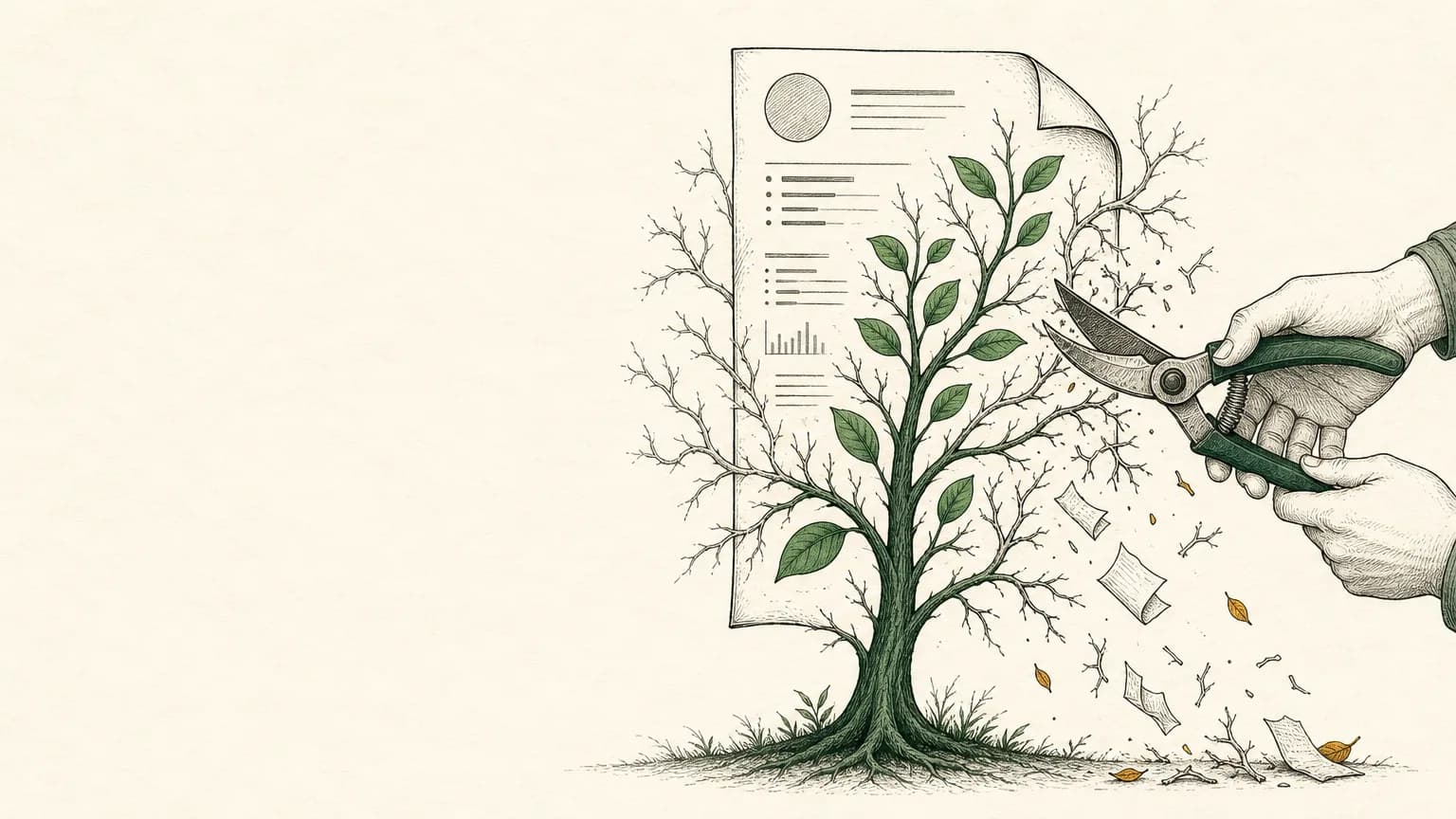
Cut unsupported claims, low-relevance details, duplicated proof, stale history, and filler before you touch font size or margins.
That is the fastest way to shorten a resume without weakening it. In 45-60 minutes, you should be able to finish with either a defensible one-page version or a clear reason page two earns space.
The mistake is treating length like a design problem. It is usually an evidence hierarchy problem.
Tiny CV's point of view is simple: a resume is a compressed evidence page. The cut pass starts with what the role needs to believe, not with how much smaller you can make the text.
This post extends the one-page resume forcing function. That article owns the why: one page makes the resume choose. This one owns the how: what to remove, what to compress, what to keep, and when layout changes are finally allowed.
What should you cut first when your resume is too long?
You should cut the weakest evidence first: claims you cannot defend, details that do not match the target role, repeated proof, stale history, and sections that take space without changing the hiring case.
Start with a five-minute target pass. Write the role, company type, or opportunity at the top of the draft. Then ask one question of every line:
Would this help the reader believe I can do this specific work?
MIT's resume checklist asks whether sections are ordered by importance to the employer, whether experience includes project, activity, and results, and whether the resume gives evidence with relevant scale.1 UC San Diego gives the bullet-level version: use more space for more relevant positions, lead with stronger accomplishments, and keep summaries short and specific.2
That is the order of operations.
Define the target. Rank the proof. Cut what does not help.
The Cut Ladder: what should go in what order?
The Cut Ladder is a resume-shortening protocol that removes weak claims before compressing strong ones.
Use the ladder in order. If you start at layout, you may preserve the wrong content in a smaller, harder-to-read package.
| Rung | Cut test | Keep test | Example | Checkpoint |
|---|---|---|---|---|
| 0. Target and constraints | You cannot name the target role or reader. | The version has a clear role, industry, or company type. | "Data analyst, healthcare operations" beats "general business resume." | Spend 5 minutes writing the target before editing. |
| 1. Unsupported claims | You could not defend the line in an interview. | The line is true, sourced, and explainable. | Cut "strategic leader" if no bullet proves leadership. | Every kept claim has evidence below it. |
| 2. Low-fit lines | The detail is true but irrelevant to this target. | It shows transferable or required proof. | Cut a retail closing-duty bullet for a software role unless it proves operations, training, or customer judgment. | The top half points toward this role. |
| 3. Duplicate proof | Two lines prove the same thing, and one is weaker. | Each line adds a new skill, scope, tool, or outcome. | Keep the strongest SQL project; compress the second. | No skill is proved three times without a reason. |
| 4. Stale or older roles | The older role repeats proof already shown by newer work. | It explains a transition, credential, or unique capability. | Compress a 2018 coordinator role to one line if newer work proves the same operations skill. | Older work gets less space unless it changes the case. |
| 5. Optional sections | The section is nice to have but not decisive. | It improves fit, scanability, or proof. | Cut hobbies first unless they show relevant leadership, organizing, or domain depth. | Summary, skills, projects, awards, and activities all pay evidence rent. |
| 6. Bullet compression | The bullet has proof but too much wording. | The action, context, and result survive. | Replace "Responsible for managing and coordinating weekly status updates" with "Coordinated weekly launch status updates for product and support." | Strong bullets remain strong after trimming. |
| 7. Layout pass | The content is already chosen and still just misses the page. | Readability and parser safety remain intact. | Tighten spacing before shrinking text below sane limits. | The final PDF is readable, selectable, and calm. |
The rough timing is enough to keep you moving: 5 minutes on the target, 10 minutes deleting obvious filler, 15-20 minutes compressing roles and bullets, 10 minutes deciding optional sections, and 10 minutes on layout.
Tiny CV works well for this pass because the markdown source stays inspectable. Mark each line Keep, Compress, Cut, or Move, then preview the page only after the evidence order is right.
What content usually fails the first cut?
The content that usually fails the first cut is content that consumes attention without proving fit.
Cut or rewrite these first:
- Generic objective statements that say you want an opportunity instead of showing why you fit.
- "References available on request."
- Photos on most U.S. private-sector resumes, unless the country, industry, or role expects one.
- Unrelated hobbies that do not show transferable skill.
- Stale coursework, old class projects, long unit lists, and conference lists that no longer support the target.
- Repeated tools or skills already proved in stronger bullets.
- Duties with no contribution.
- AI-polished adjectives with no evidence.
University of Queensland's one-page resume guide, created with Madelaine-Marie Judd, recommends cutting photos when space is tight because they do not show job fit, and it points to relevance cuts before emergency formatting tricks.3 UC Berkeley is more nuanced on unrelated jobs and hobbies: unrelated jobs can show necessary skills, volunteer work can count like paid experience, and hobbies are usually one of the first removable sections unless they demonstrate transferable skills.4
Here is what this means for you: the section name is not the decision.
The decision is whether the line changes the hiring case for this target. A volunteer treasurer role can stay for a finance job. A generic "interests: travel, music, fitness" line probably cannot.
UBC's resume guidance says most employers spend less than one minute on the first scan of a resume.5 That does not mean you should panic. It means the page should not ask the reader to dig through low-signal lines before they reach the proof.
How do you trim resume bullets without weakening the proof?
You trim resume bullets by ranking the proof inside each role, cutting repeated or duty-only lines, and preserving the action, context, and result.
Start inside the most relevant role. Put the best target-matched bullet first, then ask whether the next bullet adds something new.
As a working guideline, use 3-5 bullets for the most relevant current or recent role, 1-3 bullets for supporting roles, and one-line entries for older or low-fit roles when space is tight. UC San Diego gives the 3-5 bullet average and explicitly says not all experiences need the same length because relevance should control space.2
Before cutting a strong bullet, cut the weaker parts of the sentence:
- "Responsible for"
- repeated verbs
- repeated tools
- repeated projects
- setup phrases like "worked closely with"
- bullets that prove the same skill less clearly than another bullet
Use this compression test:
Action verb + specific work + context or purpose
Weak:
- Responsible for helping with onboarding emails and making updates when needed.
Better:
- Updated onboarding emails with product and support so new users received clearer setup steps.
Tighter if the role needs space:
- Updated onboarding emails to clarify new-user setup steps.
If you want the fuller bullet-writing protocol, use how to write resume bullets without inventing metrics. The same rule applies here: an AI agent can suggest tighter phrasing, but it must not invent numbers, tools, titles, scope, or outcomes.
When should older roles, projects, and education get compressed?
Older roles, projects, and education should get compressed when they repeat proof already shown by newer or more relevant work.
Do not cut old work just because it is old. Cut it when it no longer earns space.
Keep older experience when it does one of three jobs:
- It proves a unique skill the newer work does not show.
- It explains a career transition.
- It satisfies a credential, domain, or process requirement.
Compress it when it only preserves history. UC Berkeley says a resume can be more than one page when extensive related experience warrants it, but most student and recent-graduate resumes should fit one page when experiences are clearly and concisely described.4 UQ suggests excluding early-career roles that do not relate to the position when other edits have not solved the length problem.3
Projects follow the same rule. UC San Diego says to include relevant and significant projects only, name your role when useful, and explain the goal, technologies, processes, and your specific contribution.2
Education details should shrink as stronger work evidence grows. Early-career candidates may need coursework and campus projects. Later, a degree line plus highly relevant credentials may be enough.
Does the summary, skills section, or project section earn the space?
A summary, skills section, or project section earns space only if it makes the target clearer, adds proof, or improves scanability for a real requirement.
Think of this as evidence rent.
The section must pay for its lines.
For summaries, keep one only when it translates fit faster than the first role. If it repeats the headline or pads the page with adjectives, cut it or use a headline. For the deeper decision, use resume summary vs no summary.
For skills, keep searchable and defensible skills. Cut soft-skill lists that are not proved anywhere else. NACE's 2026 Spring Update found that more than half of early-career employer respondents cited 10+ skills they wanted to see on resumes, from a survey conducted February 12-March 17, 2026 with 185 total respondents.6
That is not permission to dump 10 skills.
It is a reason to make the important skills findable and defensible. NACE president and CEO Shawn VanDerziel emphasized in the same release that candidates need examples, not just labels, and should be ready to explain their proficiency.6
For the full filter, use how to write a resume skills section.
For projects, keep fewer and stronger. A project section should prove current fit, not act as storage for every class assignment, side build, or abandoned idea. Move deeper explanation to a portfolio, GitHub README, or public CV link when the extra context helps a human reader.
What layout changes are safe after the evidence is right?
Safe layout changes come after the Cut Ladder, and they should preserve readability, text parsing, and a calm first scan.
Use layout only when the content is already chosen.
MIT's checklist frames resume margins as 0.5-1.0 inches and font size as 10-12 pt.1 UC San Diego similarly says font typically should not be smaller than 10 and margins should not be smaller than 0.5, while warning against columns, photos, graphics, and overly artistic formatting.2
Those numbers are not decoration. They are guardrails.
Try these before shrinking type:
- Shorten section headers.
- Combine location and date lines when readable.
- Use consistent spacing instead of generous spacing everywhere.
- Tighten contact details into one clean block.
- Remove repeated role metadata.
- Use concise bullets before reducing the font.
Be careful with parser-risk tricks. Greenhouse's own support documentation, scoped to Greenhouse Recruiting, says parse failures can come from graphics, photos, image resumes, complex tables, headers, footers, text boxes, columns, unclear sections, and files larger than 2.5 MB.7
That does not mean every ATS behaves like Greenhouse. It does mean your final application file should be boring in the ways systems appreciate: readable text, clear sections, and no hidden contact details.
Tiny CV's paper preview belongs here, not earlier. Preview the page after the evidence decisions. If the resume only fits after it becomes a wall of tiny text, the cut pass is not done.
One-page resume cut checklist
A one-page resume cut checklist should confirm that the target, proof, compression, layout, and truth all survived the edit.
Use this after the ladder.
Target
- Can the reader identify the target role or direction in the first screenful?
- Does the top half point toward the same role the job posting describes?
- Did this version avoid duplicating a generic all-purpose resume?
Cut
- Did you remove unsupported claims before trimming strong evidence?
- Did you cut low-fit lines, repeated skills, stale details, and filler?
- Did every optional section pay evidence rent?
Compress
- Are the strongest 4-6 proof points still visible?
- Did the most relevant role get more space than supporting roles?
- Did bullet compression preserve action, context, and result?
Layout
- Is the PDF still readable at roughly 10 pt or above?
- Are margins still sane, generally no smaller than 0.5 inch?
- Can the text be selected and copied in a reasonable order?
Defend
- Could you defend every kept line in an interview?
- Did every number, tool, title, and outcome survive a truth check?
- Did an AI agent add anything you did not provide?
NACE senior editor Kevin Gray reported from Job Outlook 2025 that nearly 90% of responding employers looked for evidence of problem-solving ability on college-student resumes, nearly 80% looked for teamwork, and written communication, initiative, work ethic, and technical skills mattered to at least 70% of respondents.8 The survey ran from August 5 to September 16, 2024 and had 237 total respondents.8
The useful word is evidence.
A quick before-and-after compression
Before:
Operations Coordinator, BrightCart
- Responsible for weekly vendor communication and follow-up.
- Helped maintain product launch checklist.
- Worked with support team on customer issues.
- Assisted with internal documentation updates.
- Participated in weekly meetings with product and operations teams.
After:
Operations Coordinator, BrightCart
- Coordinated weekly vendor follow-up for launch readiness, keeping product
  and operations aligned on open blockers.
- Updated support-facing launch notes so customer issues, owner names, and
  resolution steps lived in one shared checklist.
What changed?
The weaker bullets were not deleted because the work was fake. They were compressed because the stronger bullets already carried the proof: coordination, launch operations, support documentation, and cross-functional follow-through.
A Tiny CV workflow for cutting without losing facts
A Tiny CV cut workflow starts from the markdown source of truth and ends with a readable PDF for systems and a clean public link for humans.
Use this sequence:
- Duplicate the Tiny CV markdown source into a role-specific version.
- Write the target role, company type, or opportunity at the top.
- Mark every line
Keep,Compress,Cut, orMove. - Run the Cut Ladder in order: unsupported, low-fit, duplicated, stale, optional sections, bullets, layout.
- If an AI agent helps, prompt it to cut only from provided facts and flag anything it cannot verify.
- Review the diff manually and restore any claim the agent weakened or distorted.
- Use paper preview to check one-page fit and readability.
- Export the PDF for application systems.
- Share the hosted Tiny CV link when a human reader needs the current, clean version.
The final page should feel chosen.
Not cramped. Not inflated. Chosen, readable, and defensible.
Footnotes
-
MIT Career Advising & Professional Development, "Resume checklist and worksheet," https://capd.mit.edu/resources/resume-checklist/ ↩ ↩2
-
UC San Diego Career Center, "Resume Guide," https://career.ucsd.edu/resources/guides/resume.html ↩ ↩2 ↩3 ↩4
-
University of Queensland, "How to shorten your resumé to one page," published September 22, 2023, https://study.uq.edu.au/stories/how-shorten-your-resume-one-page ↩ ↩2
-
UC Berkeley Career Engagement, "Resumes," https://career.berkeley.edu/prepare-for-success/resumes/ ↩ ↩2
-
University of British Columbia Student Services, "Resumes and cover letters," https://students.ubc.ca/career/career-resources/resumes-cover-letters/ ↩
-
National Association of Colleges and Employers, "The High-Impact Skills College Students Should Showcase on Their Resumes," April 23, 2026, https://www.naceweb.org/about-us/press/2026/the-high-impact-skills-college-students-should-showcase-on-their-resumes ↩ ↩2
-
Greenhouse Support, "Unsuccessful resume parse," last updated March 2, 2026, https://support.greenhouse.io/hc/en-us/articles/200989175-Unsuccessful-resume-parse ↩
-
Kevin Gray, National Association of Colleges and Employers, "What Are Employers Looking for When Reviewing College Students' Resumes?", December 9, 2024, https://www.naceweb.org/talent-acquisition/candidate-selection/what-are-employers-looking-for-when-reviewing-college-students-resumes ↩ ↩2