
An AI engineer resume in 2026 should prove that you can turn models, data, retrieval, evaluation, and infrastructure into a working AI product.
That is different from proving that you have touched Python, called an LLM API, or completed a machine learning class. The page needs shipped software evidence, but the AI-specific proof is narrower: what you built, why it worked, how you evaluated it, where it failed, and what stayed true in production.
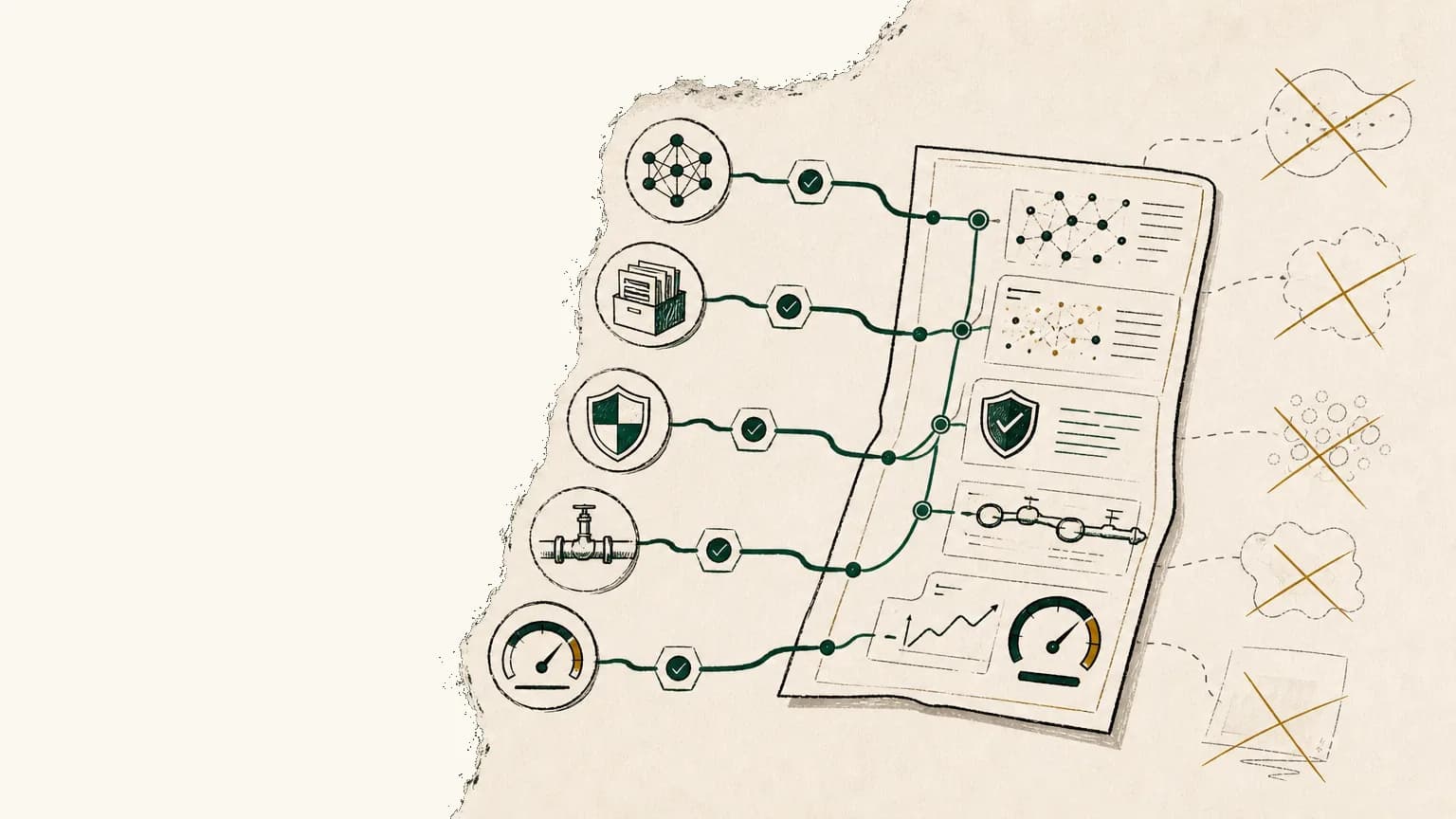
Think of the resume as a proof map.
Microsoft Learn frames AI engineers as people who pull data from sources, create and test machine learning models, and use APIs or embedded code to implement AI applications.1 Coursera's role overview similarly describes AI engineers as builders of applications and systems that apply AI and machine learning in real settings.2
The labor-market numbers are adjacent, not exact. The U.S. Bureau of Labor Statistics does not maintain a clean "AI engineer" occupation, but its computer and information research scientists page is useful context: 2024 median pay was $140,910, the occupation had 40,300 jobs in 2024, employment is projected to grow 20% from 2024 to 2034, and about 3,200 openings are projected each year.3
Do not turn that into "AI engineers make exactly this much."
Your resume has a simpler job: make the strongest true evidence easy to verify. Tiny CV helps because the markdown source keeps AI-system claims inspectable, the paper preview forces one-page tradeoffs, and a public CV link gives a human reader a current version when a PDF is too flat.
What should an AI engineer resume prove in 2026?
An AI engineer resume should prove shipped AI product work, model and data judgment, evaluation discipline, safety awareness, serving infrastructure, and measurable workflow or product impact.
A broad software engineer resume proves that you can build, debug, ship, and maintain software. An AI engineer resume still needs that foundation, but the differentiator is the machine-learning system around it.
Did you choose the retrieval strategy? Did you measure groundedness? Did you set up evaluation before release? Did you monitor drift or failure modes? Did you control latency or cost? Did you help a team understand when the AI system should not answer?
Those are not decorative details. They are the hiring case.
The BLS adjacency caveat matters here because "AI engineer" is still a moving title. One company means LLM product engineer. Another means ML platform engineer. Another means quality, evals, and reliability for AI outputs. Treat labor data as background, then let the target job description decide which proof lanes deserve the most space.
The AI engineer proof map: five lanes hiring teams can scan
The AI engineer proof map turns your resume from a list of AI tools into five scan-ready lanes of evidence.
Use it before you write bullets. If a claim does not fit one of these lanes, it may still belong on the resume, but it should earn the space.
| Proof lane | What it proves | Weak evidence | Stronger evidence | Seniority signal |
|---|---|---|---|---|
| Shipped AI product or application | You can put AI into a user workflow | "Built AI chatbot" | Released an AI feature with user flow, fallback behavior, review path, and deployment state | Junior: project demo. Mid-level: production feature. Senior: product pattern or platform used by multiple teams |
| Model, data, and retrieval choices | You understand the inputs and system boundaries | "Used GPT-4 and LangChain" | Chose corpus, chunking, embedding, retrieval, prompt, model, or data strategy for a stated constraint | Junior: explainable project choices. Mid-level: improved retrieval or data quality. Senior: reusable architecture or governance |
| Evaluation and safety | You can test behavior before and after release | "Tested model outputs" | Built eval set, measured failure modes, documented guardrails, reviewed unsafe outputs, or tracked regressions | Junior: clear eval method. Mid-level: eval harness. Senior: evaluation standard, incident reduction, or risk process |
| Serving infrastructure | You can keep the system running | "Deployed model" | Owned API integration, inference path, monitoring, latency, cost, CI/CD, rollback, or observability | Junior: reproducible deployment. Mid-level: reliable service ownership. Senior: platform reliability and operating model |
| Product or workflow impact | You can connect AI work to real use | "Improved productivity" | Showed adoption, internal use, reduced manual review class, faster workflow, fewer escalations, or a validated rollout | Junior: credible user test. Mid-level: team or customer workflow. Senior: cross-functional leverage |
Google Cloud's MLOps guidance is useful because it treats ML delivery as more than model code: it includes source control, testing, deployment, continuous training, and monitoring.4 AWS describes MLOps as practices for automating and simplifying ML workflows and deployments across development, validation, release, infrastructure, and operations.5
NIST adds the risk lens. The AI Risk Management Framework is meant to help teams incorporate trustworthiness into the design, development, use, and evaluation of AI systems.6 For generative AI, NIST AI 600-1 specifically warns about confabulation, fabricated content, provenance, pre-deployment testing, and ongoing monitoring.7
Here is what this means for you: "I used AI" is not enough. The resume should show how the AI system was made testable, useful, and bounded.
Tiny CV's source-of-truth workflow pairs well with this table. Keep raw evidence notes under each lane first. Then polish the public bullet only after the model, dataset, metric, deployment, and outcome claims are verified.
What should each section earn on an AI engineer resume?
Each section on an AI engineer resume should make the target proof lane easier to verify.
For experienced candidates, the default order is:
- Header with selective verification links.
- Optional one-line target summary.
- Experience.
- Selected AI projects, only when they add distinct proof.
- Skills taxonomy.
- Education and certifications.
For students, researchers, and career switchers, education and projects can move above limited work history. That is not padding. It is ordering the evidence so the strongest proof appears first.
The header is a verification strip. Include GitHub, demo, paper, portfolio, technical writing, LinkedIn, or a public Tiny CV link when it helps a human inspect your work. Do not add six links because technical candidates are "supposed" to have links.
Yale's Office of Career Strategy treats the technical resume as flexible, with sections such as header, optional summary, education, technical skills, work experience, and projects or leadership experience.8 It also warns that complex formatting such as tables or graphic images may not parse well in applicant tracking systems, which is why the final exported resume should stay simple even if your drafting notes are rich.8
Carnegie Mellon's School of Computer Science resume guide makes the same prioritization point: required sections include contact information, education, experience and/or projects, and skills, but the most important or relevant content should come first.9
For an AI engineer, the summary should be narrow if you use one:
AI engineer focused on RAG evaluation, production inference, and internal knowledge workflows.
Not:
Passionate AI engineer leveraging cutting-edge technology to drive innovation.
The first line gives a reader a target lane. The second line gives them a fog machine.
Which AI engineer projects are resume-worthy?
AI engineer projects deserve resume space when they prove something your work history does not yet prove.
That might be retrieval design, evals, data preparation, guardrails, deployment, observability, latency, cost control, or product integration. A class project can be strong if it has constraints. A side project can be weak if it only wraps an API and calls itself intelligent.
Use this RAG project proof anatomy before you decide whether the project earns space.
| RAG proof part | What to document | Weak version | Resume-worthy version |
|---|---|---|---|
| Corpus or source | What knowledge the system used | "Used company docs" | "Indexed 420 internal support articles after removing stale policy pages" |
| Chunking and retrieval | How context was selected | "Added vector search" | "Compared section-level and paragraph-level chunks for support-answer grounding" |
| Evaluation method | How output quality was checked | "Tested responses" | "Built 80-question eval set from repeated support cases and tracked grounded answers" |
| Failure mode | What went wrong and how you handled it | "Handled hallucinations" | "Added fallback when retrieved context did not support a policy answer" |
| Latency or cost constraint | What made the system practical | "Optimized performance" | "Cached repeated retrieval calls for internal users during weekly policy reviews" |
| User workflow | Who used it and when | "Made a chatbot" | "Embedded answer draft into support triage so agents could review before sending" |
| Deployment state | Whether it actually ran | "Built demo" | "Deployed internal pilot with logging, review queue, and rollback path" |
NIST AI 600-1 is especially relevant here because it treats source verification, testing, and monitoring as part of managing generative AI risk.7 D. Sculley, Gary Holt, Daniel Golovin, Eugene Davydov, Todd Phillips, Dietmar Ebner, Vinay Chaudhary, Michael Young, Jean-Francois Crespo, and Dan Dennison made the durable ML-systems point in "Hidden Technical Debt in Machine Learning Systems": ML creates maintenance pressure through data dependencies, feedback loops, configuration, and system-level interactions.10
So a strong RAG resume entry is not "built chatbot."
It is closer to:
- Built a RAG support assistant over 420 internal articles, evaluated answers
  against 80 repeated support questions, and added fallback behavior when
  retrieved context did not support a policy answer.
Notice what is missing: fake users, fake revenue, fake accuracy, fake interview magic.
If the project never shipped, say so. A deployed internal pilot is different from a local demo. A fine-tuned model is different from using an API. Retrieval is different from training. Human review is different from full automation.
Precision is the point.
How do you write AI engineer bullets without inventing metrics?
AI engineer bullets should connect action, AI system context, constraint, evaluation or operational evidence, and a verified outcome.
Use this formula:
Action + AI system context + constraint + evaluation/operation evidence + verified outcome
The outcome does not always need to be a number. It can be shipped to internal users, passed a documented eval threshold, reduced a class of manual review, added monitoring, reproduced an experiment, validated a rollout, documented fallback behavior, or exposed failure modes before release.
The rule from writing resume bullets without inventing metrics still applies: a real number can sharpen a claim, but a guessed number creates interview risk.
| Pattern | Before | After |
|---|---|---|
| Weak AI project | Built an AI chatbot using LangChain and OpenAI | Built a RAG assistant over product docs, compared two chunking strategies, and documented unsupported-answer fallbacks before sharing the demo with support teammates |
| Overclaimed AI bullet | Increased model accuracy 35% and eliminated hallucinations | Evaluated generated answers against a 120-case QA set, flagged unsupported responses for human review, and tracked recurring failure modes for the next prompt and retrieval pass |
| Truthful production proof | Worked on AI features for sales team | Integrated an LLM draft step into the sales-notes workflow, added review-before-send behavior, and logged accepted, edited, and rejected drafts so the team could inspect output quality |
The middle version is calmer because it is defensible. It does not promise that hallucinations vanished. NIST's generative AI profile explicitly treats confabulation and fabricated content as risks to manage, not as a problem a resume bullet should pretend to erase.7
Tiny CV's agent-safe workflow is useful here. Let an agent tighten phrasing, classify bullets by proof lane, and flag unsupported claims. Then you verify every model, dataset, eval, deployment, metric, and outcome before the bullet leaves your draft.
If an agent turns "tested with teammates" into "validated at enterprise scale," reject the edit.
Which AI engineer skills should you list?
AI engineer skills should be grouped by proof type, not dumped into one long keyword line.
Tool lists age fast. The durable skill is the work pattern behind the tool.
| Skill group | Examples | Resume rule |
|---|---|---|
| Languages and core engineering | Python, TypeScript, SQL, Go, APIs, testing | List what you can use in real work or explain in an interview |
| ML and modeling | supervised learning, embeddings, PyTorch, TensorFlow, scikit-learn | Back important claims with projects, coursework, research, or production work |
| LLM and RAG | prompt design, retrieval, chunking, reranking, grounding, tool use | Separate API use from retrieval design, evals, or fine-tuning |
| Data and retrieval | data cleaning, vector search, search relevance, pipelines | Show corpus, scale, quality, or failure handling where possible |
| Evaluation and safety | eval sets, red teaming, human review, guardrails, provenance | Tie to documented tests, known risks, or release checks |
| Serving and MLOps | CI/CD, monitoring, inference APIs, rollback, latency, cost | Show the operating constraint, not just the platform name |
| Cloud and infrastructure | AWS, GCP, Azure, Docker, Kubernetes, Terraform | Include when the role expects deployment or reliability proof |
| Product and collaboration | workflow design, PM/design/support partnership, docs | Prove through bullets, not soft-skill labels |
Microsoft's AI engineer framing includes software development, programming, data science, data engineering, data sourcing, model creation and testing, and AI application implementation.1 Google Cloud and AWS both make the lifecycle explicit: ML systems need testing, deployment, validation, monitoring, and operations, not just notebooks.45
For generative AI, keep four claims separate:
- Used an AI API inside a product.
- Built a retrieval or evaluation pipeline.
- Fine-tuned or trained a model.
- Owned production reliability for an AI system.
Those are different claims. Do not let the skills section blur them together.
What should AI engineer resume examples look like by seniority?
AI engineer resume examples should show section order and proof allocation, not fake full resumes for imaginary candidates.
Use skeletons instead.
New grad or career switcher AI engineer skeleton
For a new grad or career switcher, lead with the best evidence of foundations and project discipline.
Header: name, email, location, GitHub or demo if readable, public CV link if current.
Education or training: degree, certificate, bootcamp, research lab, or focused coursework only when relevant.
Projects: two or three substantial AI projects with corpus/data, model or retrieval choice, evaluation method, deployment state, and link.
Experience: internships, research, teaching, analyst work, support engineering, or domain work that proves useful context.
Skills: grouped technical skills, not a keyword cloud.
Cut tiny API wrappers, generic coursework, and projects that cannot be explained under pressure.
Mid-level generative AI product engineer skeleton
For a mid-level AI engineer, lead with production ownership.
Header: selective links, including a public Tiny CV link if it helps a human read the current version.
Experience: AI product features, retrieval systems, eval work, integration paths, monitoring, latency/cost work, and cross-functional delivery.
Selected projects: only if they prove a different lane from work experience.
Skills: grouped by product AI, retrieval, evals, infrastructure, and core engineering.
Education: compressed unless recent or unusually relevant.
Cut old class projects and broad "AI enthusiast" language. The reader needs to see shipped judgment.
Senior AI quality, evals, or ML platform engineer skeleton
For a senior AI engineer, the resume should prove leverage, standards, reliability, and risk management.
Header: links to writing, talks, open source, public CV, or portfolio only when they verify senior judgment.
Summary: optional one-line scope statement, such as "Senior AI engineer focused on eval strategy and production reliability for LLM workflows."
Experience: platform decisions, eval standards, governance, incident reduction, reliability patterns, mentoring, and cross-functional adoption.
Selected writing or open source: include only if it clarifies technical leadership.
Skills: compressed and grouped. Senior resumes do not need to prove every library one by one.
The senior page should not read like a ticket log. It should show where your judgment changed how other people built, shipped, evaluated, or operated AI systems.
How do you build the Tiny CV version without losing the facts?
The safest Tiny CV workflow for an AI engineer resume is to collect evidence first, map it to proof lanes, draft in markdown, verify every claim, then tailor emphasis without changing history.
Use this sequence:
- Collect raw proof notes: roles, projects, links, datasets, corpora, models, retrieval choices, eval methods, deployment notes, incidents, constraints, and verified outcomes.
- Map each bullet to one of the five AI proof lanes.
- Draft in Tiny CV markdown so the source stays inspectable.
- Keep private verification notes near public claims while drafting.
- Ask an agent to classify bullets by proof lane and flag unsupported AI claims.
- Rewrite for the target role without adding facts.
- Use paper preview to decide what earns the one-page slot.
- Publish a public Tiny CV link for humans when it helps.
- Export a PDF for application systems that require one.
A concise agent prompt can help:
Review this AI engineer resume draft.
Classify each bullet by proof lane: shipped AI product, model/data/retrieval,
evaluation/safety, serving infrastructure, or product/workflow impact.
Flag unsupported claims about models, datasets, metrics, deployment, ownership,
or outcomes.
Suggest tighter wording using only the facts provided.
Do not ask the agent to make you sound more senior. Ask it to make the evidence easier to inspect.
That is the standard for a good AI engineer resume: not louder, not trendier, not stuffed with every tool name in the posting.
Easier to verify.
Footnotes
-
Microsoft Learn, "Training for AI engineers," https://learn.microsoft.com/en-us/training/career-paths/ai-engineer ↩ ↩2
-
Coursera Staff, "What Is an AI Engineer? (And How to Become One)," updated February 23, 2026, https://www.coursera.org/articles/ai-engineer ↩
-
U.S. Bureau of Labor Statistics, Occupational Outlook Handbook, "Computer and Information Research Scientists," https://www.bls.gov/ooh/computer-and-information-technology/computer-and-information-research-scientists.htm ↩
-
Jarek Kazmierczak, Khalid Salama, and Valentin Huerta, Google Cloud Architecture Center, "MLOps: Continuous delivery and automation pipelines in machine learning," last reviewed August 28, 2024, https://docs.cloud.google.com/architecture/mlops-continuous-delivery-and-automation-pipelines-in-machine-learning ↩ ↩2
-
Amazon Web Services, "What is MLOps? - Machine Learning Operations Explained," https://aws.amazon.com/what-is/mlops/ ↩ ↩2
-
National Institute of Standards and Technology, "AI Risk Management Framework," released January 26, 2023, https://www.nist.gov/itl/ai-risk-management-framework ↩
-
National Institute of Standards and Technology, "Artificial Intelligence Risk Management Framework: Generative Artificial Intelligence Profile," NIST AI 600-1, July 2024, https://nvlpubs.nist.gov/nistpubs/ai/NIST.AI.600-1.pdf ↩ ↩2 ↩3
-
Yale Office of Career Strategy, "STEMConnect: Technical Resume Sample," https://ocs.yale.edu/resources/stemconnect-technical-resume-sample/ ↩ ↩2
-
Carnegie Mellon University School of Computer Science, "Step-by-Step Resume Guide," https://www.cmu.edu/career/documents/resources-by-college/scs-resume-guide-2020.pdf ↩
-
D. Sculley, Gary Holt, Daniel Golovin, Eugene Davydov, Todd Phillips, Dietmar Ebner, Vinay Chaudhary, Michael Young, Jean-Francois Crespo, and Dan Dennison, "Hidden Technical Debt in Machine Learning Systems," Advances in Neural Information Processing Systems 28, 2015, https://papers.nips.cc/paper_files/paper/2015/hash/86df7dcfd896fcaf2674f757a2463eba-Abstract.html ↩