
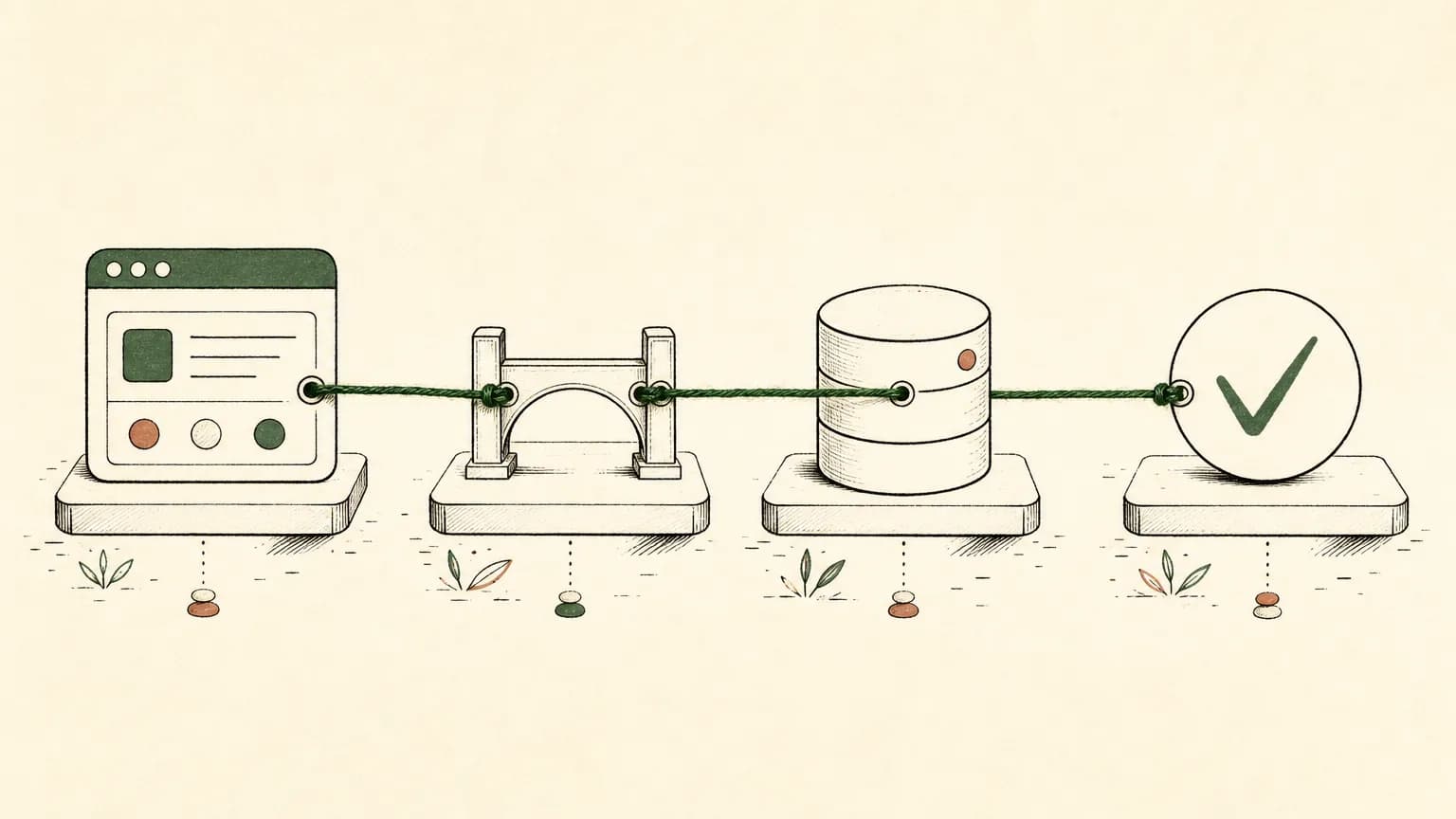
A full-stack engineer resume should prove that you can carry a product slice across the interface, API, data model, deployment path, and follow-up work. The strongest page does not say "frontend plus backend" over and over. It shows where you connected the pieces and made the system easier to use, operate, or change.
That is the full-stack standard for 2026: end-to-end product proof on one calm, truthful page.
Tiny CV's view is simple here. A resume is a compressed evidence page, not a persuasion trick. For a full-stack engineer, the evidence has to show range without looking unfocused.
What should a full-stack engineer resume prove?
A full-stack engineer resume should prove that you can move between product behavior, interface constraints, server logic, data, quality, and release tradeoffs without dropping the thread.
The role sits between several job descriptions. BLS says software developers analyze user needs, design software, maintain programs, document systems, and often work on teams with other developers, QA analysts, and testers.1 BLS also describes web developers as people who create and maintain websites, with responsibility for technical aspects such as performance and capacity.2 O*NET's web developer profile is even closer to the full-stack reality: web applications, application databases, interactive interfaces, browser compatibility, performance, scalability, server-side code, infrastructure, and integrations all appear in the same role description.3
That does not mean you need to prove everything equally.
It means your resume needs a clear through-line. A full-stack engineer is not valuable because they touched every layer once. They are valuable because they can choose where the product problem actually lives.
Use this as the answer-first test:
- Can you explain the user or business problem?
- Can you show the interface or workflow people used?
- Can you show the API, data, or service work that made it possible?
- Can you show how you tested, shipped, monitored, or maintained it?
- Can you explain what changed afterward?
If the resume cannot answer those questions, it is probably just a stack list.
The Full-Stack Proof Map
The Full-Stack Proof Map helps you decide what earns space before you polish sentences.
Fill it with private notes first. Then turn only the strongest, defensible evidence into public resume bullets.
| Proof area | What the reader needs to believe | Strong evidence | Weak claim to avoid | Where it belongs |
|---|---|---|---|---|
| Product slice ownership | You can carry a feature across layers | Shipped workflow, conversion step, admin tool, onboarding flow, billing path, internal platform surface, or customer-facing feature | "Worked across the full stack" | Top experience bullets |
| Frontend judgment | You can make behavior usable and maintainable | State management, routing, forms, accessibility, loading/error states, performance, component reuse, design collaboration | "Built UI with React" | Experience and selected projects |
| Backend judgment | You can design the server-side path behind the feature | API design, auth, validation, queues, background jobs, integrations, service boundaries, error handling | "Built APIs" | Experience bullets near product context |
| Data judgment | You understand data shape, migration, and query tradeoffs | Schema design, indexes, data cleanup, migrations, reporting model, privacy constraint, rollback plan | "Used PostgreSQL" | Experience or project bullets |
| Reliability and quality | You care whether the whole path keeps working | Tests across layers, observability, incident follow-up, release checklist, monitoring, rollback, support handoff | "Wrote clean code" | Experience bullets |
| Collaboration | You can coordinate across product, design, support, QA, and platform | Design reviews, API contracts, docs, cross-team handoff, customer support loop, technical explanations | "Strong communicator" | Bullets with audience and artifact |
| Scope control | You know where your depth is and where you partnered | Clear ownership boundary, pair work, escalation, architectural tradeoff, dependency management | "Did everything" | Summary, bullets, project notes |
This map also protects you from the main full-stack resume trap: trying to look broad by becoming vague.
MIT Career Advising and Professional Development tells candidates to describe experiences with specificity, use action verbs, include how work was performed, and record factual accomplishments rather than just responsibilities.4 That advice matters more for full-stack resumes than for almost any other technical role because the work crosses so many layers.
Specificity is what makes range credible.
How should you structure a one-page full-stack resume?
Lead with the strongest relevant product proof, then use the rest of the page to explain the stack, scope, and operating quality behind it.
For most full-stack engineers, the best structure is:
- Header with role target, links, and location if useful.
- Optional one-line summary only if it sharpens the target.
- Experience with the strongest end-to-end bullets first.
- Skills grouped by product layer.
- Projects only when they prove something not already covered by experience.
- Education or certifications, kept compact.
The summary is optional. Use it when it clarifies a real lane:
Full-stack product engineer focused on onboarding, billing, and internal workflow tools across React, TypeScript, Node.js, and PostgreSQL.
Skip it when it only repeats generic traits:
Passionate full-stack developer with strong problem-solving skills and experience in many technologies.
A one-page resume is the target, not a prison. But the one-page pressure is useful because it forces you to choose the most relevant proof. Tiny CV's paper preview is built for this kind of edit: if the page only fits after you delete your best shipped workflow, the structure is wrong; if it only fits after shrinking every margin, the resume has not chosen yet.
For the broader page-fit logic, pair this with the one-page resume forcing function. For tailoring decisions, use should you tailor your resume for every job?.
How should full-stack engineers group skills?
Group full-stack skills by what they help prove, not by every tool you have ever touched.
Stack Overflow's 2025 Developer Survey is a useful reminder that the developer-tool surface is enormous.5 A full-stack resume cannot win by listing the whole surface. It wins by making the relevant surface readable.
Use a grouped skills taxonomy like this:
| Skill group | What to list | Resume rule |
|---|---|---|
| Frontend | TypeScript, React, Next.js, forms, routing, state, accessibility | Priority tools should also appear in shipped-work bullets |
| Backend | Node.js, Python, Rails, APIs, auth, queues, background jobs | Tie to product behavior, integration, reliability, or data flow |
| Data | PostgreSQL, MySQL, Redis, migrations, indexes, analytics tables | Show schema or query judgment, not just database names |
| Testing and quality | Playwright, Vitest, Jest, pytest, contract tests, monitoring | Strong when connected to release confidence or defect prevention |
| Infrastructure | Vercel, AWS, Docker, CI/CD, observability, feature flags | Include only when you owned or influenced the delivery path |
| Product domain | Billing, onboarding, admin tools, marketplaces, internal operations, developer tools | Useful when the target role needs that context |
Avoid proficiency theater. "Expert in React, Node, Postgres, AWS, Docker, Kubernetes, GraphQL, Redis, Terraform, and Figma" can sound less credible than a shorter, cleaner grouping backed by bullets.
The skills section is retrieval. The bullets are proof.
What should full-stack resume bullets look like?
Full-stack resume bullets should connect user-facing behavior to the technical path that made it work.
Use this formula:
Action + product surface + technical path + constraint + truthful outcome
The outcome does not need to be a perfect metric. Use real numbers when you can verify them. When you cannot, use scope, audience, release state, before-and-after behavior, operating constraint, or maintenance result.
Here are examples:
| Raw note | Weak version | Stronger full-stack version |
|---|---|---|
| Built onboarding | Built onboarding feature using React and Node | Shipped a self-serve onboarding flow with React forms, server-side validation, and PostgreSQL profile setup so new accounts could complete configuration without a support handoff |
| Fixed billing bug | Fixed billing API bugs | Debugged plan-change failures across checkout UI, webhook handling, and subscription state, then added regression tests for the downgrade and renewal paths |
| Worked on admin | Developed admin dashboard | Built an internal account-review dashboard with filtered routes, role-based API access, and query pagination for support teammates reviewing customer setup issues |
| Improved performance | Optimized app performance | Reduced dashboard load bottlenecks by moving repeated summary queries into a cached endpoint and adding loading states for slow reports |
| Added tests | Wrote full-stack tests | Added Playwright coverage for signup, email verification, and first-project creation to catch interface/API regressions before weekly release |
Notice the pattern. The strong versions do not try to prove full-stack range by naming every tool. They show the product path: interface, server behavior, data, quality, and user or team effect.
This is also where AI editing can help if you keep control of the facts. Ask an agent to compress, reorder, and flag unsupported claims. Do not ask it to invent metrics or turn "helped debug" into "owned platform reliability." Use the resume diff checklist before accepting model-edited language.
What kind of projects belong on a full-stack engineer resume?
Projects belong on a full-stack engineer resume when they show inspectable end-to-end judgment that paid work does not already prove.
For early-career candidates, bootcamp grads, career switchers, and engineers moving into a new product lane, one strong full-stack project can be valuable. But it has to show more than a tutorial stack.
A full-stack project earns space when it has:
- A real user or workflow.
- Authentication or permission boundaries when relevant.
- Data model decisions you can explain.
- Error states, empty states, validation, and loading behavior.
- A deployed demo or readable repository.
- Tests or a clear manual verification path.
- Accessibility and performance care where the interface matters.
- A short note about tradeoffs or what you would improve next.
W3C's WCAG 2 overview says WCAG documents explain how to make web content more accessible to people with disabilities and that WCAG 2.2 has guidelines organized under four principles: perceivable, operable, understandable, and robust.6 Google's Core Web Vitals guidance describes LCP, INP, and CLS as field metrics for load speed, responsiveness, and visual stability, with thresholds used to classify user experience.7
Those standards are not resume decorations. They are proof prompts.
If a project claims "production-quality UI," show keyboard behavior, semantic structure, stable layout, and measured performance. If it claims "secure API," show authentication, authorization, validation, and error handling without overselling the threat model.
OWASP's API Security project names API risks such as broken object-level authorization, broken authentication, object-property authorization issues, and unrestricted resource consumption.8 A junior project does not need enterprise security language. But a full-stack candidate should be able to explain how protected resources, IDs, validation, and rate-sensitive work were handled.
How do you avoid looking unfocused?
You avoid looking unfocused by choosing a full-stack lane for each resume version.
"Full-stack" can mean product engineer, web platform engineer, startup generalist, internal tools engineer, frontend-leaning full-stack engineer, backend-leaning full-stack engineer, or technical founder. Those are different stories.
Use this decision table before tailoring:
| Target role | Lead with | De-emphasize |
|---|---|---|
| Product-focused full-stack engineer | Shipped workflows, product outcomes, user problems, UX/API/data connection | Deep infrastructure detail unless it affected the feature |
| Frontend-leaning full-stack engineer | UI systems, state, accessibility, performance, API integration | Database internals that do not matter to the role |
| Backend-leaning full-stack engineer | API design, data model, reliability, integrations, tests | Visual polish claims with no product effect |
| Internal tools engineer | Operations workflow, admin surfaces, permissions, reporting, support handoff | Consumer UI language that hides business process proof |
| Startup generalist | Ambiguity, shipping cadence, ownership, pragmatic tradeoffs, customer feedback | Giant skills inventory with no shipped examples |
Tailoring changes emphasis, not facts. Tiny CV works well here because you can keep one markdown source of truth and create role-specific versions from the same factual record. The full-stack version can lead with end-to-end product slices. The frontend version can lead with interface proof. The backend version can lead with API, data, and reliability proof.
The facts stay stable.
The order changes.
What should full-stack engineers avoid claiming?
Full-stack engineers should avoid claims that sound broad but collapse under follow-up questions.
Cut or rewrite these:
- "Owned the entire stack" when you owned one part and collaborated on the rest.
- "Architected" when you implemented from someone else's design.
- "Scaled to millions" without a source, system, or personal contribution.
- "Expert" labels for tools you cannot explain in depth.
- Security claims with no authorization, authentication, validation, or review detail.
- Performance claims with no metric, method, or before state.
- "AI-built" project claims that hide what you personally understand.
- Every framework you tried once.
NACE's career-readiness competencies include communication, critical thinking, teamwork, technology, leadership, professionalism, and career development.9 A full-stack resume should demonstrate those competencies through work artifacts: specs, reviews, tradeoffs, tests, releases, docs, incidents, customer feedback, or cross-team decisions.
Labels do not prove judgment.
Artifacts do.
A 25-minute full-stack resume audit
Use this audit before sending a full-stack resume:
- Circle every bullet that shows a product surface or workflow.
- Underline the API, data, infrastructure, or integration work behind that surface.
- Mark every bullet that names a user, customer, teammate, or internal operator.
- Highlight every skill that appears only in the skills section and nowhere in a bullet or project.
- Remove tools you cannot explain in an interview.
- Move the strongest end-to-end proof into the first two experience bullets.
- Add one quality signal: test, monitoring, validation, accessibility, performance, rollback, or support handoff.
- Check that the target lane is clear within the first scan.
- Export a PDF and inspect the actual one-page layout.
- Ask an AI assistant to flag unsupported claims, duplicated tools, and vague full-stack language, then approve every final line yourself.
If the audit makes the resume longer, you are not done. The point is to replace vague breadth with stronger proof, not add another layer of explanation.
A practical Tiny CV workflow for a full-stack resume
Start in Tiny CV with one markdown source for the facts: roles, dates, shipped workflows, APIs, schemas, migrations, tests, incidents, metrics, links, private notes, and source links for any numbers.
Then create the full-stack version:
- Choose the target lane: product, frontend-leaning, backend-leaning, internal tools, startup generalist, or platform-adjacent.
- Fill the Full-Stack Proof Map privately.
- Select three to five product slices that best prove end-to-end judgment.
- Write bullets with product surface, technical path, constraint, and truthful outcome.
- Group skills by layer and remove unsupported tool names.
- Use Tiny CV's paper preview to keep the page readable before shrinking type.
- Keep private proof notes out of the public hosted CV.
- Export the PDF for application systems.
- Share a public Tiny CV link when a human should inspect links, projects, or the clean browser version.
- If an agent helps, require diff review and reject any claim that does not trace back to your real work.
That workflow pairs with your resume needs a source of truth and how to use resume keywords without keyword stuffing. The full-stack resume should be broad enough to show range and narrow enough to show judgment.
The winning page is not the one with the most technologies.
It is the one where a reader can see what you shipped, how the layers connected, and why the work held together.
Footnotes
-
U.S. Bureau of Labor Statistics, "Software Developers, Quality Assurance Analysts, and Testers," Occupational Outlook Handbook, accessed June 20, 2026. https://www.bls.gov/ooh/computer-and-information-technology/software-developers.htm ↩
-
U.S. Bureau of Labor Statistics, "Web Developers and Digital Designers," Occupational Outlook Handbook, accessed June 20, 2026. https://www.bls.gov/ooh/computer-and-information-technology/web-developers.htm ↩
-
National Center for ONET Development, ONET OnLine, "15-1254.00 - Web Developers," updated 2026, accessed June 20, 2026. https://www.onetonline.org/link/summary/15-1254.00 ↩
-
MIT Career Advising & Professional Development, "Resumes," accessed June 20, 2026. https://capd.mit.edu/resources/resumes/ ↩
-
Stack Overflow, "2025 Developer Survey," accessed June 20, 2026. https://survey.stackoverflow.co/2025/ ↩
-
W3C Web Accessibility Initiative, "WCAG 2 Overview," updated May 26, 2026, accessed June 20, 2026. https://www.w3.org/WAI/standards-guidelines/wcag/ ↩
-
Bryan McQuade and Barry Pollard, "How the Core Web Vitals metrics thresholds were defined," web.dev, last updated May 7, 2025, accessed June 20, 2026. https://web.dev/articles/defining-core-web-vitals-thresholds ↩
-
OWASP Foundation, "OWASP API Security Project," accessed June 20, 2026. https://owasp.org/www-project-api-security/ ↩
-
National Association of Colleges and Employers, "What is Career Readiness?", accessed June 20, 2026. https://www.naceweb.org/career-readiness/competencies/career-readiness-defined/ ↩