
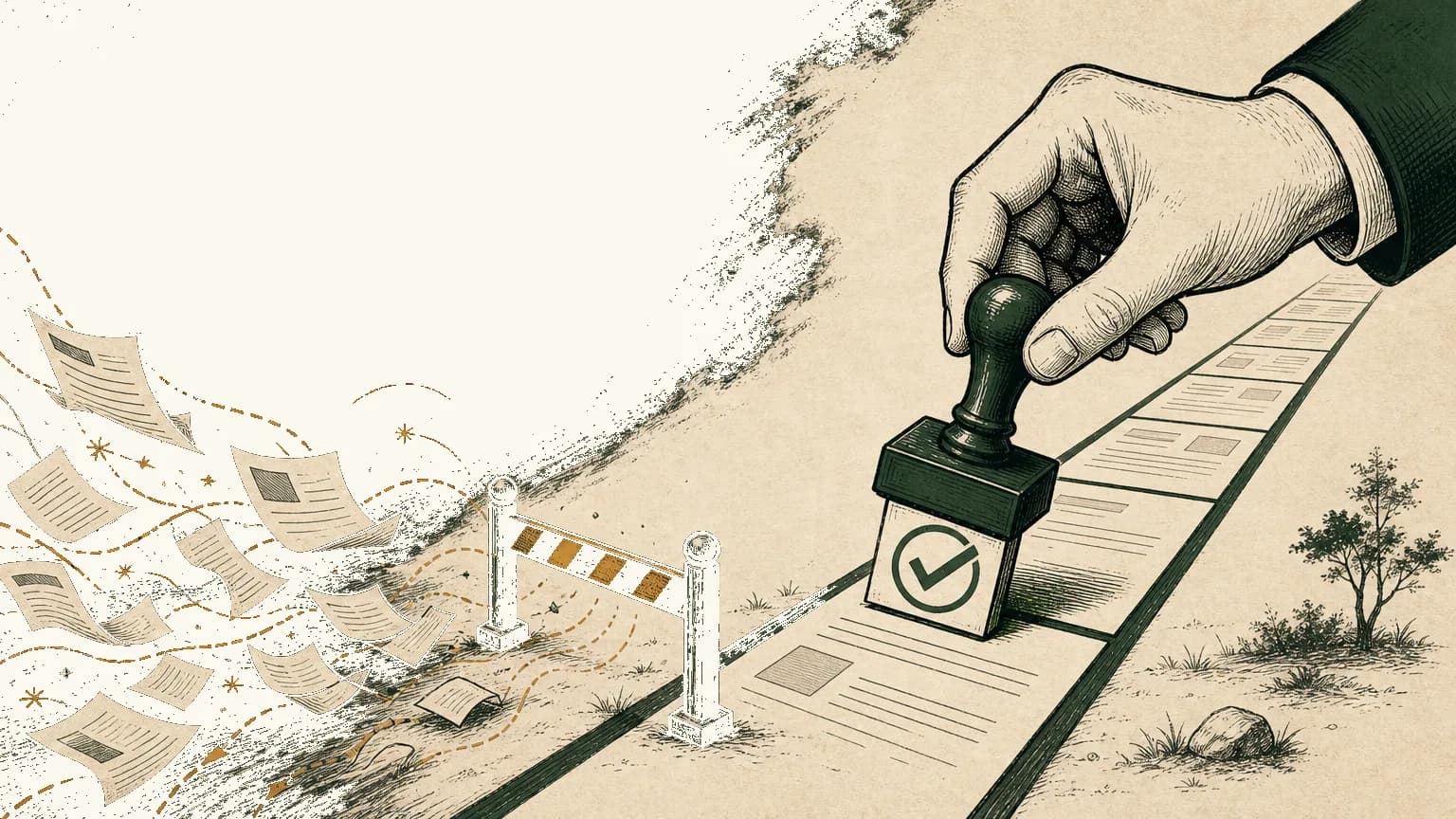
The safest way to review an AI-edited resume is to approve the diff, not the whole rewritten document.
Compare the original line, the AI change, why it changed, and your decision: approve, edit, reject, or send back. That gives you a clean resume where every stronger claim still traces back to real work.
Think of the AI version like a contractor's markup on your house plans. Some edits make the structure cleaner. Some quietly move a load-bearing wall.
Spend 20 minutes on the review: 5 minutes scanning high-risk facts, 10 minutes filling the diff table, and 5 minutes previewing the final resume before export. Tiny CV helps because a markdown-first resume keeps the edit inspectable instead of hiding it inside a polished rewrite.
OpenAI's own Help Center warns that ChatGPT can sound confident even when it is wrong, and recommends verifying important information from reliable sources.1 OpenAI's 2025 hallucination research, credited to Adam Tauman Kalai and contributors, makes the same point from the model side: systems can be rewarded for guessing instead of saying they do not know.2
The article's SimpleQA example is useful context, not resume advice: gpt-5-thinking-mini showed a 26% error rate and 52% abstention rate, while OpenAI o4-mini showed a 75% error rate and 1% abstention rate.2
That is not a reason to avoid AI.
It is a reason to review the change.
What belongs in a resume diff approval table?
A resume diff approval table should show the original line, the AI change, why it changed, and the decision you made.
This is the reusable artifact. Copy it into a note, spreadsheet, markdown file, or PR-style review comment.
| Original line | AI change | Why it changed | Decision |
|---|---|---|---|
| Helped support team document repeated setup issues | Turned recurring setup issues into a shared onboarding checklist for support and implementation teams | Clearer action, same scope, proof still visible | Approve |
| Worked with product on billing bugs | Owned billing reliability improvements that reduced churn | Adds ownership and an outcome not in the original evidence | Reject |
| Updated React forms for account settings | Rebuilt account settings in React and TypeScript to clarify validation errors | Useful direction, but "rebuilt" may overstate scope | Edit |
| Improved onboarding emails | Need source material: number of emails, audience, before state, and any outcome | The AI cannot judge impact from the line alone | Send back |
Use four decision labels:
| Decision | Rule |
|---|---|
| Approve | The fact is unchanged, the wording is clearer, the relevance is stronger, and the proof remains visible. |
| Edit | The direction is useful, but the wording overstates scope, hides proof, sounds generic, or needs more precise language. |
| Reject | The edit invents or changes an employer, title, date, credential, tool, customer, metric, ownership level, or outcome. |
| Send back | The AI needs source material, uncertainty labels, before/after diffs, or a narrower prompt before you can judge the edit. |
Yale Office of Career Strategy puts AI resume review after drafting and human review, then uses it to compare a resume against a job description.3 That order matters.
You understand the content first. Then AI helps you refine it.
Step 1: Which facts should you check before you read the wording?
Check factual fields before deciding whether the AI phrasing sounds good.
The rule is facts before phrasing.
Scan these 11 high-risk fields first: employer names, job titles, dates, locations, credentials, tools, customers, project scope, metrics, ownership verbs, and outcomes.
Small drift can still become inaccurate. "Helped" turns into "owned." A support queue becomes "customer research." A tool you touched once becomes a skill you imply you can use in an interview.
NIST's Generative AI Profile names "confabulation" as confidently stated false content, and it also frames human-AI configuration as a real risk area.4 For resumes, the practical control is simple: the AI can improve clarity, ordering, and emphasis, but it cannot witness work you did not do.
Monster's Elizabeth Muenzen makes the consumer-facing version of the same point: ChatGPT works best when you provide accurate work history, job details, metrics, tools, and context, then review the output for accuracy.5
If a change touches a fact category, slow down.
If it only improves grammar, flow, or ordering, you can move faster.
Step 2: Did the edit improve role fit without changing the claim?
Accept AI edits that make true evidence easier for the target reader to see; reject edits that create new evidence.
Tailoring is not identity rewriting.
A safe edit can reorder bullets, replace vague terms with accurate language from the job description, sharpen verbs, remove weak proof, or compress low-relevance detail. UC Berkeley Career Engagement tells students to analyze the position description, tailor the resume to each job, focus on outcomes, quantify when possible, and target accomplishments to employer needs.6
That is legitimate role fit.
Unsafe edits add skills without evidence, inflate "helped" to "led," change dates or titles, imply direct customer ownership, or attach revenue, security, or reliability outcomes you cannot explain.
UCLA Career Center says employers typically scan a resume for 15-30 seconds, so the document needs to be clear, concise, and matched to employer needs.7 Treat that as career-center guidance, not a law of nature. The useful takeaway is that the strongest proof should not be buried.
Tiny CV's role-specific versions work best when they come from the same resume source of truth. Change the emphasis for the role. Do not change the facts.
If you want the broader rule, use this companion guide to tailor your resume without changing the facts.
Step 3: Can every stronger claim point to proof?
Every stronger resume claim should point to proof you can explain in an interview.
Use this proof ladder:
| Proof level | What to do |
|---|---|
| Direct artifact | Approve if the wording matches the artifact. |
| Measured metric | Approve if you know where the number came from. |
| Counted scope | Approve if the count is honest: users, tickets, emails, teammates, projects, releases. |
| Credible estimate | Edit with approximate language and keep the basis clear. |
| Qualitative evidence | Use audience, frequency, constraint, before state, after state, tools, or decision role. |
| No proof | Reject or send back for source material. |
Numbers are not the only proof.
NACE names eight career-readiness competencies, including communication, critical thinking, leadership, teamwork, and technology.8 Those are real signals, but they need evidence. "Strong communicator" is weak. "Wrote weekly rollout notes for product, support, and sales" is stronger because the audience and cadence do the work.
This is also where AI-edited resumes get fragile.
An unsupported metric feels efficient because it compresses a messy story into one line. But if you cannot name the dashboard, report, project note, customer list, support queue, or manager feedback behind it, the number is not ready.
Use this guide to write resume bullets without inventing metrics when the AI keeps pushing every bullet toward a percentage.
Step 4: What should you send back to ChatGPT or an AI agent?
Send AI rejected or unclear edits with narrower instructions, source material, and a request to mark uncertainty instead of guessing.
Bad prompt:
Make this sound more impressive.
Better prompts:
Rewrite this bullet without adding facts.
Mark every claim that needs evidence.
Preserve title, dates, tools, metrics, and ownership level exactly.
Give me before/after edits with an approval reason for each change.
Those four prompts change the job. The model is no longer being asked to invent polish. It is being asked to make reviewable edits.
Anthropic's hallucination-reduction guidance recommends giving the model permission to say it does not know, grounding responses in supplied material, and making claims checkable with citations or supporting evidence.9 That maps cleanly to resume work.
If the model lacks source material, it should say what is missing.
If it changed a claim, it should show the change.
If it cannot defend a stronger version, it should leave the original alone.
For agent-specific boundaries, use the safest way to let an AI agent edit your resume.
Step 5: What should you check before applying?
Before applying, check the final resume for factual accuracy, proof, supported role fit, readable formatting, and the correct delivery format.
Run this 9-item pre-apply checklist:
- Employer names, titles, dates, locations, degrees, and certifications are unchanged unless you deliberately corrected them.
- Metrics are traceable to proof.
- Role keywords are supported by actual bullets.
- The strongest proof is visible in the first screenful.
- Formatting is readable without relying on columns, graphics, hidden text, or tiny type.
- Links work.
- The PDF exports cleanly.
- The public link matches the intended audience.
- Private notes, evidence scraps, salary details, references, and confidential client information are not public.
Case Western Reserve University's resume checklist asks candidates to verify basics such as contact information, education, position title, employer, city, state, dates, bullet points, action verbs, and relevant skills.10 UC Berkeley also warns that ATS uploads work best with standard fonts, standard section titles, conventional work-history formatting, and without headers, footers, text boxes, tables, colors, pictures, or graphics.6
Tiny CV gives you three final review surfaces: the markdown, the paper preview, and the output. Preview the one-page paper view before exporting a PDF or sharing the hosted link.
Use the PDF when a system requires a file.
Use the public CV link when a person needs a clean, current version to read, forward, or revisit. The deeper comparison is here: public CV link vs PDF.
How does the Tiny CV workflow make resume diffs safer?
Tiny CV makes resume diffs safer by keeping the source inspectable, the AI edit reviewable, and the final output under human approval.
Use this 7-step workflow:
- Start from the markdown source of truth, not a blank prompt.
- Ask the AI agent for before/after edits with an approval reason for each change.
- Fill the diff approval table and classify every meaningful change.
- Verify fragile claims against proof: title, dates, metrics, tools, scope, ownership, and outcomes.
- Keep role-specific versions as controlled edits from the same source record.
- Preview the one-page paper view and fix spacing or readability before sending.
- Share the public CV link for human readers and export a PDF when an application system requires a file.
The markdown does not guarantee truth by itself.
The human approval step is the guardrail.
Tiny CV is the container: source of truth, agent suggestions, diff approval, preview, hosted link, and PDF export. If you already work in markdown, the markdown resume workflow gives you the base pattern.
The final question is not "Did the AI make this sound better?"
The better question is: "Can I explain why every changed line belongs?"
Footnotes
-
OpenAI Help Center, "Does ChatGPT tell the truth?", https://help.openai.com/en/articles/8313428-does-chatgpt-tell-the-truth ↩
-
OpenAI, "Why language models hallucinate," September 5, 2025, https://openai.com/index/why-language-models-hallucinate/ ↩ ↩2
-
Yale Office of Career Strategy, "Resumes," https://ocs.yale.edu/channels/resumes/ ↩
-
National Institute of Standards and Technology, "Artificial Intelligence Risk Management Framework: Generative Artificial Intelligence Profile," NIST AI 600-1, July 2024, https://nvlpubs.nist.gov/nistpubs/ai/NIST.AI.600-1.pdf ↩
-
Elizabeth Muenzen, Monster, "How to Use ChatGPT to Write Your Resume (Prompts & Expert Guide)," updated April 23, 2026, https://www.monster.com/career-advice/resume/chatgpt-resume ↩
-
UC Berkeley Career Engagement, "Resumes," https://career.berkeley.edu/prepare-for-success/resumes/ ↩ ↩2
-
UCLA Career Center, "Resumes & Cover Letters," https://career.ucla.edu/resources/resumes-cover-letters/ ↩
-
National Association of Colleges and Employers, "Career Readiness Defined," https://www.naceweb.org/career-readiness/competencies/career-readiness-defined/ ↩
-
Anthropic Claude Docs, "Reduce hallucinations," https://platform.claude.com/docs/en/test-and-evaluate/strengthen-guardrails/reduce-hallucinations ↩
-
Case Western Reserve University Center for Career Success, "Resume Checklist," https://case.edu/studentlife/careercenter/career-development/career-resources/tips-job-seekers/resumes/resume-checklist ↩