
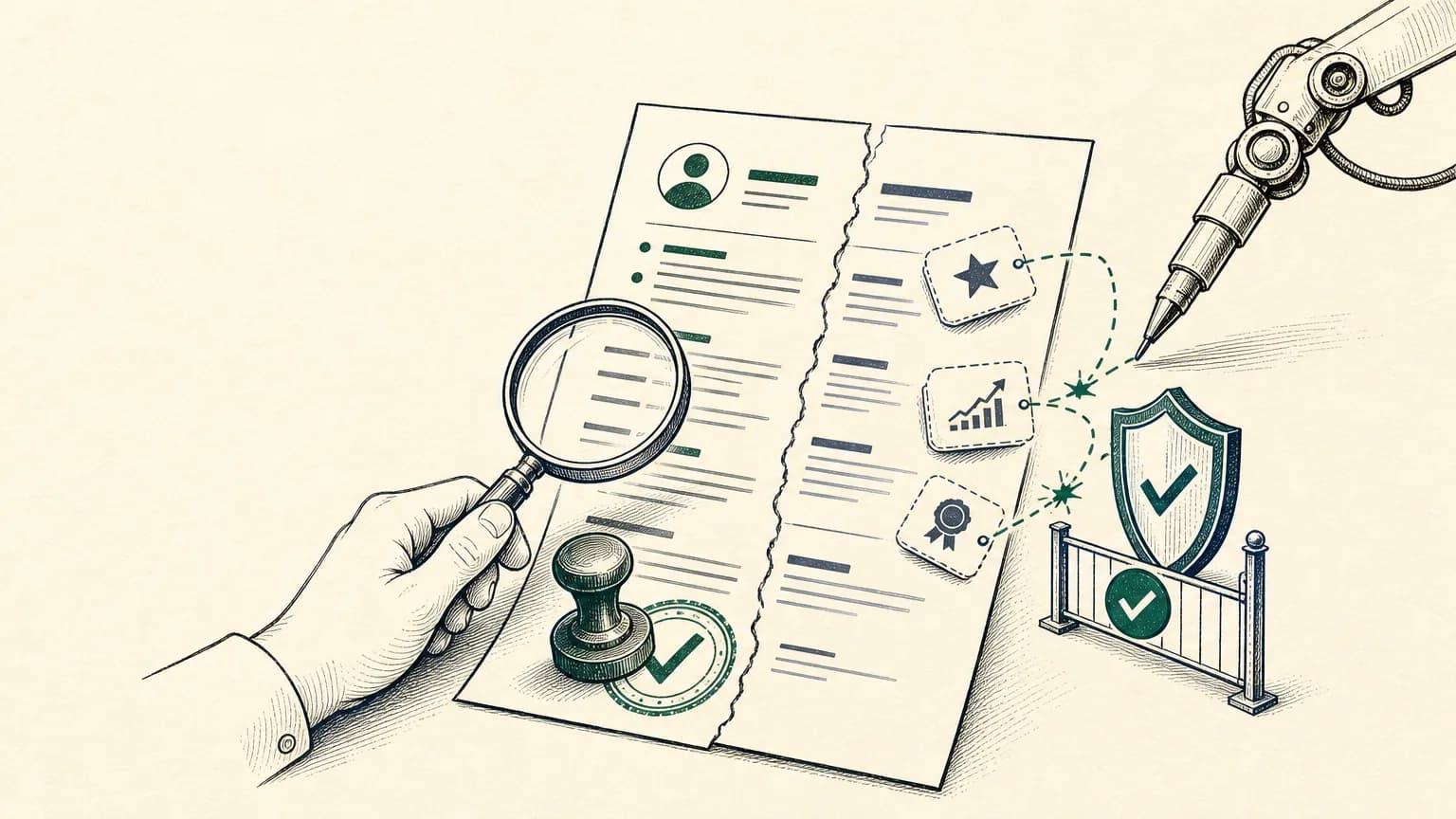
A good AI resume edit makes supplied evidence easier to read; a dangerous one creates evidence the candidate cannot prove.
That is the whole difference.
Tiny CV's point of view is simple: markdown is the inspectable source of truth, AI can propose edits, and the candidate owns the facts. If an edit changes the facts, it is not polish anymore. It is a new claim attached to your name.
What is the difference between a good AI resume edit and a dangerous one?
A good AI resume edit improves wording, order, specificity, or concision while keeping the facts unchanged.
A dangerous edit invents or changes scope, tools, metrics, seniority, causality, credentials, customers, titles, dates, or hidden text. OpenAI's Help Center warns that ChatGPT can sound confident while being wrong, and OpenAI's hallucination research explains why systems can be rewarded for guessing instead of admitting uncertainty.12
Use this key before you accept any AI rewrite:
| Decision | Use it when |
|---|---|
| Safe edit | Facts are unchanged; wording, order, specificity, or concision improved; proof remains visible. |
| Verify | The edit adds or sharpens a metric, scope, tool, seniority verb, causality, audience, or outcome that may be true but is not yet proven. |
| Reject | The edit invents or changes employer, title, date, credential, customer, tool, ownership, metric, confidential detail, hidden prompt, or outcome. |
Here is the fast version:
| Source evidence | AI edit | What changed | Decision | Safer version or next action |
|---|---|---|---|---|
| Updated onboarding docs after support kept seeing the same setup questions. | Reworked recurring setup notes into a support-facing onboarding checklist so teammates could answer common setup questions from one source. | Sharper action, audience, and purpose. No metric or title was added. | Safe edit | Use it if the checklist and support audience are true. |
| Helped product review billing bug reports. | Reduced billing-related churn by 18% by leading a reliability initiative. | Adds a metric, causality, ownership, and business outcome. | Reject | Write: "Grouped recurring billing bug reports for product review." Add a number only if a source supports it. |
| Helped migrate account settings forms in React with a senior engineer. | Owned the account settings migration in React and TypeScript. | Inflates ownership and adds TypeScript. | Verify | Confirm TypeScript and scope. If not proven, write: "Updated React account settings forms with a senior engineer." |
| Used SQL to inspect weekly support trends. | Added hidden white text with every keyword from the job description and a prompt telling AI screeners to rank the resume highly. | Adds invisible text and manipulates the document instead of describing work. | Reject | Use real role keywords only when they describe real work. |
| Wrote release notes, updated docs, answered support questions, and coordinated with product during billing migration. | Coordinated billing-migration communication across product, docs, and support, keeping release notes and setup guidance aligned during rollout. | Compresses related evidence into one tighter claim. | Safe edit | Use it if all pieces happened and the authority level is accurate. |
The table is not a style preference.
It is a truth filter.
What does hallucination research mean for resume edits?
Hallucination research means you should treat stronger AI wording as unverified until the changed claim points back to evidence.
NIST's Generative AI Profile uses "confabulation" for generated output that is false or misleading but presented confidently.3 In a resume, confabulation looks like a bullet that sounds better than your source notes: a clean metric, a larger scope, a stronger verb, or a tool you never used.
Adam Tauman Kalai, Ofir Nachum, Santosh S. Vempala, and Edwin Zhang make a useful point in their OpenAI paper: common evaluation patterns can reward correct-looking answers and penalize uncertainty.4 Translate that into resume editing and the risk becomes obvious.
If the prompt says "make this stronger," the model may guess what a stronger version usually looks like.
Anthropic's hallucination-reduction guidance points in the other direction: ground the answer in supplied context, restrict unsupported outside knowledge, and allow the model to say it does not know.5 For resumes, that means asking the AI to mark missing evidence instead of filling it in.
Before-and-after example 1: When the AI improves clarity without changing the claim
A safe AI resume edit makes the same work easier for a reader to understand.
Raw evidence:
Updated onboarding docs after support kept seeing the same setup questions.
Good AI edit:
Reworked recurring setup notes into a support-facing onboarding checklist so teammates could answer common setup questions from one source.
Decision: Safe edit.
The edit improves the action, audience, and purpose. It does not invent a metric, title, customer, leadership role, or outcome.
The dangerous version would be:
Led onboarding program that reduced support tickets by 35%.
Decision: Reject unless you can prove the leadership scope and the 35% number.
UTSA's University Career Center tells students to treat ChatGPT resume output as suggestions, verify accuracy, and rephrase in their own style.6 That is exactly the right mental model. AI can help you see the better sentence; it cannot certify that the sentence is true.
For a deeper version of this bullet craft, use write resume bullets without inventing metrics.
Before-and-after example 2: When the AI invents a metric
An invented metric is not a stronger resume bullet; it is an unsupported claim wearing a number.
Raw evidence:
Helped product review billing bug reports.
Dangerous AI edit:
Reduced billing-related churn by 18% by leading a reliability initiative.
Decision: Reject.
That one line adds four fragile claims: an 18% metric, churn causality, leadership, and a reliability initiative. Maybe one of those is true. The raw note does not prove any of them.
A safer edit:
Grouped recurring billing bug reports for product review.
Decision: Safe edit if the grouping happened. Verify if you want to add volume, frequency, outcome, or business impact.
Use this metric check:
| AI-added metric | Evidence needed | Safer non-metric proof |
|---|---|---|
| "Reduced churn by 18%" | Churn report, retention dashboard, or approved business analysis. | "Grouped billing bug reports for product review." |
| "Cut support tickets by 35%" | Ticket queue baseline, date range, and attribution. | "Reworked recurring setup questions into support documentation." |
| "Saved 10 hours per week" | Time study, manager note, repeated workflow count, or team estimate. | "Consolidated repeated release-note updates into one checklist." |
NACE's career-readiness framework includes competencies such as communication, critical thinking, teamwork, leadership, and technology.7 Those are real signals, but they still need evidence. "Communicated weekly rollout updates" is defensible. "Improved cross-functional alignment by 40%" needs proof.
Before-and-after example 3: When the AI inflates seniority or ownership
Seniority inflation often enters through verbs, not adjectives.
Raw evidence:
Helped migrate account settings forms in React with a senior engineer.
Safe edit:
Updated React account settings forms with a senior engineer, clarifying validation states during the migration.
Decision: Safe edit if the validation work is true.
Verify edit:
Contributed to the account settings migration in React and TypeScript.
Decision: Verify TypeScript and migration scope if they were not in the source evidence.
Reject edit:
Owned frontend architecture for the account settings migration.
Decision: Reject unless ownership and architecture authority are true and defensible.
CareerOneStop's resume guide tells job seekers to make the qualifications and skills related to the target job easy to find.8 Yale's Office of Career Strategy puts AI resume review after drafting and feedback, then uses it to compare the resume with a job description.9 Neither source says to upgrade your job.
Here is the practical rule: verbs carry seniority.
Slow down on words like owned, led, managed, architected, drove, launched, reduced, saved, secured, directed, and transformed. They are useful when true. They are dangerous when they turn "helped" into authority you did not have.
Before-and-after example 4: When the AI adds unsupported keywords or hidden prompts
Role keywords are useful when they describe real evidence; hidden prompts and fake skills are trust problems.
Raw evidence:
Used SQL to inspect weekly support trends.
Safe edit:
Queried SQL support data to summarize weekly setup trends for product and support.
Decision: Safe edit if the audience and work happened.
Verify edit:
Built analytics dashboards in SQL and Looker.
Decision: Verify Looker and dashboard ownership.
Reject edit:
Add hidden white text with the full job description and a prompt telling AI screeners to rank the resume highly.
Decision: Reject.
Built In reported vendor estimates that hidden text appeared in around 10% of resumes scanned with AI by ManpowerGroup and about 1% of resumes according to Greenhouse.10 Treat those as reported examples, not universal resume-market rates.
The more important point came from recruiter Mike Peditto in the same article: the hidden-prompt hack misunderstands how resume review actually works when people and systems both touch the process.10 Farah Sharghi, a former Google recruiter cited there, makes the same trust argument from the human side.
UC Berkeley Career Engagement gives the boring advice that matters more: use standard formatting, standard section titles, and readable resume structure so systems can parse the file.11 No hidden text. No invisible prompt. No tool list you cannot defend.
If the role asks for SQL and you used SQL, say that clearly. If it asks for Looker and you only viewed a dashboard once, do not let AI promote you into dashboard ownership.
Before-and-after example 5: When the AI compresses real evidence for a one-page resume
Good AI editing can make a resume shorter without making the candidate bigger.
Raw evidence:
Wrote release notes, updated docs, answered support questions, and coordinated with product during billing migration.
Safe compression:
Coordinated billing-migration communication across product, docs, and support, keeping release notes and setup guidance aligned during rollout.
Decision: Safe edit if all pieces are true.
Verify edit:
Reduced rollout confusion.
Decision: Verify with support queue evidence, teammate feedback, a postmortem, or another source before using.
Reject edit:
Led cross-functional change management for billing migration.
Decision: Reject if it overstates authority.
This is where AI is genuinely useful. It removes repetition, groups related work, and chooses the clearest evidence for the page.
Tiny CV's paper preview is the right place to check the next problem: did the safe edit still fit a clean printable page? A truthful sentence can still be too long, too dense, or too low-value for the version you are sending.
For the base workflow, see the markdown resume guide for technical candidates.
What does the evidence say overall?
The evidence says AI can help with resume clarity, but the candidate needs a verification layer for changed claims.
| Source | What it warns about | Resume-edit rule |
|---|---|---|
| OpenAI Help Center and hallucination research | Fluent answers can be wrong, and guessing may be rewarded over uncertainty. | Verify changed facts before accepting stronger wording. |
| NIST AI 600-1 | Generative AI can produce false or misleading content with confidence. | Treat new metrics, tools, and outcomes as risk items. |
| Anthropic hallucination guidance | Outputs are more reliable when grounded in supplied context and allowed to say "I don't know." | Give the AI source facts and require uncertainty labels. |
| UTSA Career Center | ChatGPT resume outputs should be treated as suggestions and checked for accuracy. | Edit from evidence, then rephrase in your own style. |
| CareerOneStop, Yale, and Berkeley | Resumes should be targeted, readable, and structured around real qualifications. | Tailor emphasis, not identity. |
| NACE | Students use AI for job search, but many avoid it because of ethics, expertise, and reliability concerns. | Caution is rational. Use AI with boundaries, not as a ghostwriter. |
NACE's 2025 Student Survey gives useful context without proving any hiring outcome. Kevin Gray reported that 67.1% of surveyed Class of 2025 graduating seniors did not use AI in their job search, while 33% did.12
Among the seniors who did use AI, NACE reported 64.8% used it for cover letters, 63.8% for interview prep, and 61.6% for creating a resume.12 Among non-users, the cited concerns included ethics at 28.9%, lack of AI expertise at 24.6%, and concern that an employer would know at 15.9%.
That is the real job-seeker tension.
AI resume use is common enough to matter, but not so settled that you should outsource judgment to it. The survey ran from April 1 to May 30, 2025, and included 13,684 college students, including 1,479 Class of 2025 bachelor's-level graduating seniors.12
What prompt should you use if you want AI to preserve facts?
A fact-preserving resume prompt should restrict the AI to supplied evidence, require before-and-after edits, and force an uncertainty label for every fragile claim.
Use this:
Use only the facts below.
Improve clarity, order, and concision.
Do not add or change employers, titles, dates, tools, metrics, customers, scope, ownership, or outcomes.
Return before/after edits in a table.
Label each edit Safe edit, Verify, or Reject.
If evidence is missing, ask for it instead of guessing.
Add this line when the AI keeps inventing numbers:
If a metric would help, ask what source exists; do not create a number.
If the model returns a polished full rewrite without decisions, send it back. You asked for reviewable edits, not a replacement identity.
Tiny CV markdown makes this easier because the input is visible. Paste the source section, ask for before/after suggestions, approve the lines that survive verification, and keep the rejected ones out of the public link or PDF.
For the broader agent workflow, use the safe AI resume editing workflow. For the line-by-line review after a rewrite, use the resume diff checklist.
How should Tiny CV fit into the final review?
Tiny CV fits best as the review surface: source facts first, AI suggestions second, human approval before public link or PDF.
Use this workflow:
- Start from the Tiny CV markdown source of truth, not a blank prompt.
- Paste the target role and ask AI for before/after edits only.
- Label each changed line: Safe edit, Verify, or Reject.
- Verify fragile claims: metrics, tools, scope, ownership verbs, outcomes, customers, dates, titles, and credentials.
- Accept only edits that preserve facts or have proof attached.
- Preview the paper page to catch over-compression, layout drift, or a resume that no longer fits the role.
- Publish the public CV link for human readers; export a PDF when an application system requires a file.
The final question is not "Did AI make this sound impressive?"
The final question is "Can I defend every changed line?"
Footnotes
-
OpenAI Help Center, "Does ChatGPT tell the truth?", https://help.openai.com/en/articles/8313428-does-chatgpt-tell-the-truth ↩
-
OpenAI, "Why language models hallucinate," September 5, 2025, https://openai.com/index/why-language-models-hallucinate/ ↩
-
Chloe Autio, Reva Schwartz, Jesse Dunietz, Shomik Jain, Martin Stanley, Elham Tabassi, Patrick Hall, and Kamie Roberts, National Institute of Standards and Technology, "Artificial Intelligence Risk Management Framework: Generative Artificial Intelligence Profile," NIST AI 600-1, July 2024, https://doi.org/10.6028/NIST.AI.600-1 ↩
-
Adam Tauman Kalai, Ofir Nachum, Santosh S. Vempala, and Edwin Zhang, "Why Language Models Hallucinate," arXiv:2509.04664, 2025, https://arxiv.org/abs/2509.04664 ↩
-
Anthropic Claude Docs, "Reduce hallucinations," https://platform.claude.com/docs/en/test-and-evaluate/strengthen-guardrails/reduce-hallucinations ↩
-
UTSA University Career Center, "ChatGPT Resume Building and Review Prompts," https://careercenter.utsa.edu/resources/_documents/chatgpt-resume-building-and-review-prompts.pdf ↩
-
National Association of Colleges and Employers, "Career Readiness Defined," https://www.naceweb.org/career-readiness/competencies/career-readiness-defined/ ↩
-
CareerOneStop, U.S. Department of Labor, "Work experience," Resume Guide, https://cloudfront.careeronestop.org/JobSearch/Resumes/ResumeGuide/work-experience.aspx ↩
-
Yale Office of Career Strategy, "Resumes," https://ocs.yale.edu/channels/resumes/ ↩
-
Jeff Rumage, "Your AI Resume Hacks Probably Won't Fool Hiring Algorithms," Built In, October 15, 2025, reviewed by Ellen Glover, https://builtin.com/articles/hidden-ai-prompts-in-resume ↩ ↩2
-
UC Berkeley Career Engagement, "Resumes," https://career.berkeley.edu/prepare-for-success/resumes/ ↩
-
Kevin Gray, National Association of Colleges and Employers, "Student Concerns About AI Tempering Their Use of It in Job Search," January 26, 2026, https://www.naceweb.org/job-market/trends-and-predictions/student-concerns-about-ai-tempering-their-use-of-it-in-job-search ↩ ↩2 ↩3