
A product designer resume in 2026 should prove that you can turn user problems, product constraints, design decisions, and shipped work into better experiences. The portfolio carries the deeper story; the resume should make a hiring team want to open it.
That is the useful constraint.
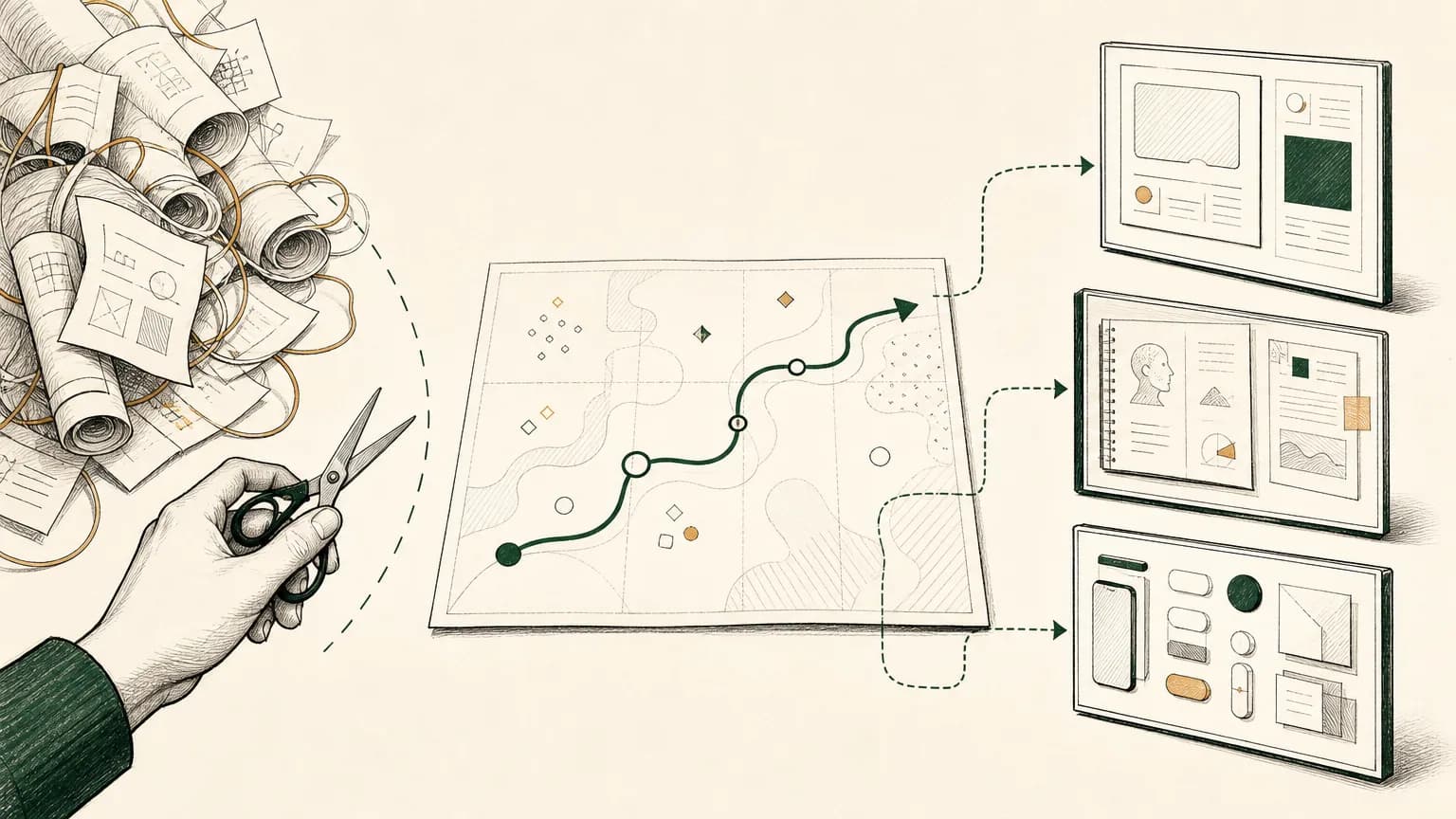
Do not try to squeeze a whole case study onto one page. Use the resume as an evidence map: what you owned, how you worked, what changed, and where the portfolio backs it up. Tiny CV's bias is simple here: the resume is the index, not the archive.
What should a product designer resume prove?
A product designer resume should prove product judgment, user understanding, interface craft, systems thinking, collaboration, and evidence of shipped impact.
O*NET's web and digital interface designer profile lists tasks such as conducting user research, analyzing user feedback, developing prototypes, creating visual concepts, choosing design tools, documenting design work, and collaborating with development teams.1 Its national employment trends page, sourced from the Bureau of Labor Statistics, reports 128,900 U.S. employees in 2024, projected employment of 137,900 in 2034, and 9,100 projected annual openings.2
That is the proof surface.
For a product designer, "designed screens in Figma" is too thin. The stronger signal is that you understood the product problem, made defensible tradeoffs, worked with partners, improved the experience, and can show the work.
Use this proof map before you write:
| Proof area | What the resume should show | What the portfolio should show |
|---|---|---|
| Product judgment | The problem, audience, constraint, and product decision | Why the problem mattered and what options you rejected |
| Research and discovery | Interviews, usability tests, analytics, support themes, or feedback loops | Research plan, synthesis, quotes, clips, journey maps, or findings |
| Interaction and visual design | Flows, states, hierarchy, components, prototypes, or shipped UI | Screens, flows, before/after states, prototypes, and rationale |
| Design systems | Components, tokens, documentation, governance, or adoption | Component examples, usage rules, edge cases, and rollout story |
| Accessibility | Specific accessibility decisions, checks, or fixes | How accessibility shaped interaction, content, color, focus, or testing |
| Collaboration | PM, engineering, research, data, support, sales, or leadership partnership | Handoffs, decision records, implementation constraints, and tradeoffs |
| Outcomes | User, product, business, operational, or team effect | Evidence trail, metrics, qualitative outcomes, or launch context |
The point is not to claim all seven areas in every role. The point is to choose the areas that are true for the job you want.
If a role is research-heavy, the resume should foreground discovery, synthesis, and decisions. If it is UI-heavy, it should foreground interaction detail, visual systems, and implementation quality. If it is senior product design, it should foreground ambiguity, leverage, systems, and cross-functional judgment.
How is a product designer resume different from the portfolio?
The resume should summarize the strongest claims; the portfolio should prove how those claims happened.
Nielsen Norman Group's UX careers research found that hiring managers often use portfolios to evaluate a candidate's thought process, workflow, business understanding, and ability to connect work to outcomes.3 That means the resume does not need to contain every research artifact, wireframe, mockup, iteration, and final screen. It needs to point at the few claims worth investigating.
Think of the two documents this way:
| Asset | Job | What belongs there |
|---|---|---|
| Resume | Help the reader decide whether to inspect your work | Role fit, scope, tools, collaborators, product area, outcomes, portfolio link |
| Portfolio | Help the reader believe your work | Case studies, visuals, process, decisions, constraints, tradeoffs, evidence |
| Public CV link | Give a human the current version to skim and forward | Clean resume, links, role-specific version, contact details |
| Give systems the requested upload file | Text-readable export with the same facts |
MIT Career Advising and Professional Development frames a portfolio as a way to showcase skills, accomplishments, projects, online identity, and professional development.4 The University of Portsmouth's product design portfolio guidance makes a similar distinction between a short application portfolio and a fuller interview portfolio.5
That is the design-resume trap: candidates try to make the resume beautiful enough to replace the portfolio.
It will not.
Your resume earns the click. Your portfolio earns the conversation.
What belongs in the top third?
The top third of a product designer resume should identify your target role, portfolio link, strongest product-design proof, and the design contexts you can defend.
For most product designers, the header should include:
- Name
- Location or work authorization context when relevant
- Portfolio URL
- LinkedIn if it is current
- Public CV link if it is cleaner or easier to share
The portfolio link is not optional for most design applications. Even when a company does not formally require one, the resume is weaker if the reader cannot inspect the work behind your claims.
After the header, use either a short summary or no summary.
Use a summary when it clarifies your lane:
Product designer focused on B2B onboarding, design systems, and accessibility,
with shipped work across research, flows, components, and engineering handoff.
Skip the summary when it only repeats the title:
Creative and passionate product designer with strong attention to detail and
excellent communication skills.
The first version helps the reader route you. The second version asks the reader to believe adjectives.
Tiny CV's one-page preview is useful here because product designers are especially tempted to keep adding visual hierarchy until the page starts behaving like a poster. The top third should scan quickly, export cleanly, and leave enough room for actual work.
How should product designer bullets be written?
Product designer bullets should connect the design action to the product context, collaborators, constraints, and result.
Harvard's resume guidance says experience bullets should start with an action verb, include details that help the reader understand accomplishments or skills, and quantify where possible.6 For designers, "where possible" matters. Some outcomes are precise numbers. Some are shipped artifacts, research decisions, adoption, quality, risk reduction, or alignment.
Use this formula:
Designed [specific product surface or system] for [user/problem/context],
using [method/tool/collaboration], resulting in [verified outcome or change].
Examples:
| Weak bullet | Stronger product designer bullet |
|---|---|
| "Created wireframes for onboarding." | "Redesigned onboarding wireframes for self-serve teams after support calls revealed repeated setup confusion." |
| "Worked on design system." | "Documented form, modal, and empty-state patterns with engineering so three product teams could reuse the same interaction rules." |
| "Improved checkout UX." | "Simplified checkout error states with PM and engineering, reducing avoidable support questions after launch." |
| "Conducted user interviews." | "Ran 12 customer interviews with research and product to identify onboarding blockers before the pricing-page redesign." |
| "Made prototypes in Figma." | "Built clickable Figma prototypes for two billing flows so stakeholders could compare risk before engineering started." |
The strongest bullet is not always the one with the biggest number. It is the one with the clearest evidence.
When you have a real number, use it and keep the source in your private notes. When you do not, use scope, audience, frequency, constraint, and decision context. That is the same standard in writing resume bullets without inventing metrics: facts before phrasing.
Which skills should a product designer include?
A product designer skills section should be grouped by capability, not dumped as a long keyword cloud.
NACE's career readiness competencies are a useful reminder that employers look for more than tool operation: communication, critical thinking, teamwork, professionalism, technology, leadership, and career development are all part of work readiness.7 For product designers, those broad competencies become visible through design work.
Use skill groups like these:
| Group | Examples to include only if true |
|---|---|
| Product design | User flows, wireframes, prototypes, IA, interaction design, visual design |
| Research | Interviews, usability testing, surveys, synthesis, journey maps, analytics review |
| Systems | Design systems, components, tokens, documentation, governance, pattern libraries |
| Accessibility | WCAG, keyboard states, focus order, contrast, alt text, inclusive design reviews |
| Collaboration | PM partnership, engineering handoff, design critiques, stakeholder workshops |
| Tools | Figma, FigJam, Miro, Framer, Webflow, Jira, Linear, Amplitude, HTML/CSS |
| Domain | B2B SaaS, consumer mobile, fintech, healthcare, marketplace, developer tools |
Do not list every design tool you have opened. A senior product designer with "Figma, Sketch, Photoshop, Illustrator, InDesign, Canva, Miro, Notion, Jira, Trello, Slack, Google Slides, Keynote, HTML, CSS, JavaScript" is not necessarily stronger than a designer who lists fewer tools with better proof.
The skills section should support the experience section. If a skill never appears in a bullet, project, portfolio case study, or job target, question whether it belongs.
How do you show accessibility without pretending to be an accessibility specialist?
Show accessibility by naming specific design decisions, checks, and constraints you actually handled.
WCAG 2.2 is a broad technical standard for making web content more accessible, and the W3C notes that its guidelines are meant to support people with many disabilities while also improving usability for users in general.8 A product designer does not need to claim legal or audit authority to show accessibility awareness. The resume can still show that accessibility shaped the work.
Good accessibility bullets are specific:
- "Added keyboard and focus-state requirements to modal specs before engineering handoff."
- "Reworked color and error-state hierarchy to keep form feedback readable in the design system."
- "Partnered with engineering to document accessible names, empty states, and focus order for account settings."
- "Included low-vision and keyboard-use scenarios in checkout prototype review."
Weak accessibility bullets are vague:
- "Passionate about accessibility."
- "Designed accessible experiences."
- "Ensured WCAG compliance."
Only claim compliance if you actually performed or owned the relevant testing and can explain the standard. Otherwise, show the piece you handled. Hiring teams can respect a precise contribution. They will distrust an inflated one.
What should entry-level, mid-level, and senior designers emphasize?
Product designer resumes should shift from promise to execution to leverage as seniority increases.
Use this structure as a starting point:
Entry-level or career-switcher product designer
Lead with portfolio projects, internships, apprenticeships, freelance work, student products, or credible shipped side projects.
Header: contact, portfolio, LinkedIn, public CV link if current.
Summary: one line naming target lane and strongest proof, such as B2B product design, mobile UX, design systems, or research-led design.
Projects: two or three projects with problem, role, method, tools, constraints, and result. Make clear whether the work was solo, team, classroom, volunteer, speculative, or shipped.
Experience: include transferable work when it proves research, customer support, product thinking, writing, operations, facilitation, or technical collaboration.
Skills: grouped capabilities, not every tool.
Mid-level product designer
Lead with shipped product work and portfolio-backed outcomes.
Header: contact, portfolio, relevant links.
Summary: optional, useful only if it clarifies product domain, platform, or design strength.
Experience: recent roles with bullets about discovery, flows, product surfaces, systems, launches, measurement, collaboration, and constraints.
Selected projects: include only if they add proof not obvious from work history.
Skills: methods, systems, tools, domains, and accessibility.
Senior or lead product designer
Lead with ambiguity, scope, systems, and organizational leverage.
Header: contact, portfolio, writing, talks, public CV link if useful.
Summary: a tight positioning line can help: design systems, growth, enterprise workflow, developer tools, AI products, marketplace design, or research-led product strategy.
Experience: product bets, cross-functional strategy, design systems, mentoring, quality standards, executive alignment, decision frameworks, team rituals, and measurable product or operational outcomes.
Selected artifacts: case studies, systems documentation, talks, writing, open-source design work, or shipped product links when public.
The higher the level, the less the resume should read like a tool inventory. Senior product design is about judgment under constraint.
How should the resume connect to the portfolio?
Every major resume claim should have a nearby path to proof in the portfolio.
That does not mean every bullet needs a case-study URL. It means the resume and portfolio should agree on the same story.
Use this check:
- If the resume says "design system," the portfolio should show components, rules, adoption, or edge cases.
- If the resume says "research," the portfolio should show method, synthesis, decisions, or findings.
- If the resume says "growth," the portfolio should show the product surface, experiment, metric, or decision path.
- If the resume says "accessibility," the portfolio should show the requirement, design decision, or test.
- If the resume says "AI product," the portfolio should show the workflow, human review point, evaluation loop, or user risk.
This is where a markdown-first resume workflow helps. Tiny CV lets you keep the resume plain enough to inspect, version, and export while linking to deeper proof. The markdown source can hold stable facts; the public version can point humans to the current portfolio; the PDF can satisfy systems that require a file.
If you use an AI agent to tailor the resume, give it the portfolio case-study summaries and ask it to map claims to proof. Do not ask it to invent outcomes. The safer pattern is the one in letting an AI agent edit your resume: it can suggest structure and phrasing, but you approve the facts.
What should you avoid on a product designer resume?
Avoid turning the resume into a visual design artifact at the expense of readability, evidence, and export quality.
Common mistakes:
- No portfolio link in the header.
- A beautiful layout that exports as hard-to-read text.
- A skills cloud with no evidence in experience.
- Case-study paragraphs squeezed into bullets.
- Visual-design claims without actual screens in the portfolio.
- Research claims without method, sample, or decision context.
- "Led redesign" when you only owned a small surface.
- Metrics copied from team dashboards without clarifying your role.
- Accessibility or AI claims that sound current but are not specific.
- A resume version that no longer matches the portfolio or LinkedIn.
The fix is not to make the resume plain and lifeless. The fix is to design the hierarchy around proof.
If the reader only has 30 seconds, they should see your role, portfolio, strongest product context, strongest design work, and credible outcomes. If they have five minutes, your links should make the story deeper, not different.
How do you build the Tiny CV version?
Build the Tiny CV version by starting with a private proof inventory, then selecting the one-page evidence that matches the product design role.
Use this workflow:
- Write the source of truth: roles, dates, product surfaces, collaborators, methods, tools, links, launches, metrics, and private proof notes.
- Choose the target product designer lane: growth, systems, research-heavy, visual/UI, enterprise workflow, mobile, AI product, or another real focus.
- Pick the matching rows from the proof map.
- Draft bullets that connect design action, product context, collaborators, and outcome.
- Add only skills that appear in the resume, portfolio, or target role.
- Link the portfolio and verify every case study supports the claims nearby.
- Preview the resume as one page before shrinking text or adding decoration.
- Publish a public CV link when a human reader needs the current browser version.
- Export a PDF when an application system asks for a file.
That workflow pairs well with the one-page resume forcing function and the resume source-of-truth workflow. The product designer version should be tailored, but the facts should not drift.
Your resume does not need to be the portfolio.
It needs to make the portfolio worth opening.
Footnotes
-
National Center for ONET Development, ONET Online, "15-1255.00 - Web and Digital Interface Designers," https://www.onetonline.org/link/summary/15-1255.00 ↩
-
National Center for ONET Development, ONET Online, "National Employment Trends: 15-1255.00 - Web and Digital Interface Designers," https://www.onetonline.org/link/localtrends/15-1255.00 ↩
-
Nielsen Norman Group, "User Experience Careers: What a Career in UX Looks Like Today," 2nd edition, 2019, https://media.nngroup.com/media/reports/free/UserExperienceCareers_2nd_Edition.pdf ↩
-
MIT Career Advising and Professional Development, "Portfolios," https://capd.mit.edu/channels/portfolios/ ↩
-
University of Portsmouth, "Product design portfolio guide," https://myport.port.ac.uk/my-course/careers-support/your-options/career-guides/product-design-career-guide/product-design-portfolio-guide ↩
-
Harvard Faculty of Arts and Sciences Mignone Center for Career Success, "Resume Template I (with bullet points)," July 2024, https://cdn-careerservices.fas.harvard.edu/wp-content/uploads/sites/161/2024/07/resume-bullets.pdf ↩
-
National Association of Colleges and Employers, "What is Career Readiness?", https://www.naceweb.org/career-readiness/competencies/career-readiness-defined/ ↩
-
World Wide Web Consortium, "Web Content Accessibility Guidelines (WCAG) 2.2," W3C Recommendation, October 5, 2023, https://www.w3.org/TR/WCAG22/ ↩